
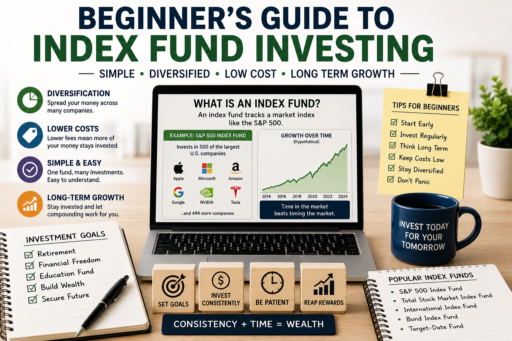
Investing can seem intimidating for beginners, especially with the thousands of stocks, funds, and financial products available today. Fortunately, index funds provide one of the simplest and most effective ways to start investing. This Index Fund Investing for Beginners explains how index funds work, why they are popular, and how beginners can use them to build long-term wealth.
Many successful investors prefer index funds because they offer diversification, simplicity, and relatively low costs. Instead of trying to pick individual winning stocks, index fund investors focus on owning a broad collection of investments through a single fund.
In 2026, index funds remain one of the most widely recommended investment options for long-term investors seeking steady growth and reduced complexity.
This Index Fund Investing for Beginners will help you understand the fundamentals and avoid common beginner mistakes.
What Is an Index Fund?
An index fund is an investment fund designed to track the performance of a specific market index.
Examples of indexes include:
- S&P 500
- Total Stock Market Index
- International Market Indexes
- Bond Market Indexes
Instead of selecting individual stocks, index funds invest in all or most of the assets within a chosen index.
Why Index Funds Are Popular
Index funds offer several advantages that make them attractive for beginners.
Benefits include:
- Broad diversification
- Lower costs
- Simple management
- Long-term growth potential
- Reduced investment complexity
Many investors view index funds as a practical foundation for long-term investing.
Benefit #1: Diversification
One of the biggest advantages discussed in this Index Fund Investing for Beginners is diversification.
When investing in an index fund, your money is spread across many companies rather than concentrated in a single stock.
This helps reduce risk and improves portfolio stability.
Benefit #2: Lower Investment Costs
Index funds generally have lower fees than actively managed funds.
Lower fees allow more of your money to remain invested and compound over time.
Even small fee differences can have a significant impact over decades.
Benefit #3: Simplicity
Many beginners feel overwhelmed when researching individual stocks.
Index funds simplify investing by providing broad market exposure through a single investment.
This simplicity often encourages long-term consistency.
Benefit #4: Long-Term Growth Potential
Historically, broad market indexes have generated long-term growth over extended periods.
While short-term fluctuations occur, long-term investors often benefit from market growth and compounding returns.
Benefit #5: Reduced Emotional Investing
Many investors make mistakes when reacting emotionally to market movements.
The Index Fund Investing for Beginners approach emphasizes maintaining a long-term perspective rather than constantly buying and selling.
A disciplined approach often improves results.
How Index Funds Work
Index funds attempt to mirror the performance of a specific index.
If the underlying index rises, the fund generally increases in value. If the index declines, the fund usually declines as well.
This approach focuses on matching market performance rather than trying to outperform it.
How Much Should Beginners Invest?
The amount depends on personal financial circumstances.
Important priorities before investing may include:
- Emergency savings
- Debt management
- Financial stability
- Long-term goals
Many investors begin with small contributions and increase them over time.
Common Types of Index Funds
- S&P 500 Index Funds
- Total Market Index Funds
- International Index Funds
- Bond Index Funds
- Target-Date Funds
Each type serves different investment objectives and risk preferences.
Common Index Fund Investing Mistakes
Many beginners make avoidable mistakes when starting their investment journey.
Common mistakes include:
- Trying to time the market
- Investing without clear goals
- Selling during market declines
- Ignoring diversification
- Focusing on short-term results
This Index Fund Investing for Beginners encourages investors to focus on long-term strategies rather than short-term market movements.
The Importance of Consistent Investing
Consistency is often more important than trying to predict market performance.
Benefits of regular investing include:
- Habit development
- Reduced emotional decisions
- Steady portfolio growth
- Long-term wealth building
Many successful investors contribute regularly regardless of market conditions.
Understand Investment Risk
All investments involve some level of risk.
Important risks include:
- Market volatility
- Economic downturns
- Inflation
- Interest rate changes
The Index Fund Investing for Beginners emphasizes understanding risk before investing and maintaining realistic expectations.
Think Long Term
Index fund investing is generally most effective when approached with a long-term mindset.
Long-term investors often benefit from:
- Compounding returns
- Market growth
- Reduced trading activity
- Greater investment discipline
Patience is often one of the most valuable investing skills.
Set Clear Investment Goals
Goals help guide investment decisions.
Examples may include:
- Retirement planning
- Financial independence
- Education funding
- Long-term wealth building
Clear goals improve focus and consistency.
Review Your Portfolio Periodically
Investments should be reviewed occasionally to ensure they remain aligned with financial objectives.
Reviews may include:
- Asset allocation checks
- Goal progress reviews
- Risk assessments
- Contribution adjustments
Regular reviews help maintain an effective long-term strategy.
Avoid Emotional Reactions
Market fluctuations are normal.
Investors who react emotionally often make decisions that harm long-term performance.
The Index Fund Investing for Beginners encourages maintaining discipline during both market gains and market declines.
Learn Continuously
Financial education improves investment decision-making.
Learning about investing, diversification, risk management, and long-term planning can help investors make more informed choices.
Knowledge often increases confidence and consistency.
Use Trusted Financial Resources
Investors interested in learning more about index funds can benefit from trusted educational resources. The Investor.gov website provides educational materials about investing, diversification, risk management, and long-term financial planning.
Reliable financial education supports better investment decisions and stronger long-term outcomes.
Additional Resources for Financial Growth
To strengthen your financial future, consider reading Financial Habits for Long-Term Success, Organize Financial Documents, and Stay Consistent With Your Budget.
These resources provide practical strategies that complement the investing principles discussed in this guide.
The Benefits of Index Fund Investing
Following the principles in this Beginner’s Guide to Index Fund Investing can provide:
- Broad diversification
- Lower investment costs
- Long-term growth potential
- Simplified investing
- Greater financial confidence
Index funds remain one of the most popular investment choices for long-term investors.
Final Thoughts
This Index Fund Investing for Beginners demonstrates why index funds are often recommended for beginners seeking a simple and effective approach to investing.
By focusing on diversification, consistency, low costs, and long-term thinking, investors can build a strong foundation for future financial success.
Remember that successful investing is usually a marathon rather than a sprint. Patience, discipline, and consistency often produce the best long-term results.