
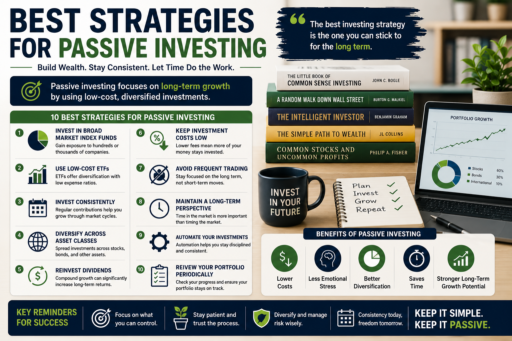
Passive investing has become one of the most popular approaches to building long-term wealth. Rather than trying to predict market movements or frequently trade investments, passive investors focus on low-cost, diversified portfolios designed to grow steadily over time. Learning the Strategies for Passive Investing can help investors reduce stress, lower costs, and improve long-term financial outcomes.
Many studies have shown that consistently investing in diversified portfolios often outperforms frequent trading and market timing attempts over long periods.
In 2026, passive investing remains attractive because it emphasizes simplicity, discipline, and long-term growth rather than short-term speculation.
The concept of Strategies for Passive Investing focuses on diversification, consistency, low costs, and long-term investing success.
What Is Passive Investing?
Passive investing involves purchasing investments designed to track market performance rather than attempting to outperform the market through active trading.
Common passive investments include:
- Index funds
- ETFs
- Broad market funds
- Target-date funds
The goal is to participate in long-term market growth while minimizing unnecessary complexity.
Why Passive Investing Is Popular
Many investors prefer passive investing because it offers several advantages.
- Lower costs
- Reduced emotional investing
- Simple portfolio management
- Long-term focus
- Broad diversification
These benefits make passive investing attractive for both beginners and experienced investors.
Strategy #1: Invest in Broad Market Index Funds
One of the most effective Strategies for Passive Investing is using broad market index funds.
These funds typically provide exposure to hundreds or thousands of companies through a single investment.
Benefits include:
- Diversification
- Low costs
- Long-term growth potential
- Simplicity
Strategy #2: Use Low-Cost ETFs
Exchange-traded funds (ETFs) are popular passive investing tools.
Many ETFs track major indexes while maintaining relatively low expense ratios.
Lower investment costs can significantly improve long-term returns.
Strategy #3: Invest Consistently
Regular investing remains a key component of passive investing success.
Benefits of consistent investing include:
- Dollar-cost averaging
- Reduced market timing risk
- Financial discipline
- Long-term wealth accumulation
Consistency often matters more than attempting to predict market movements.
Strategy #4: Diversify Across Asset Classes
Diversification helps reduce portfolio risk while supporting long-term stability.
A diversified passive portfolio may include:
- Stocks
- Bonds
- International investments
- Cash reserves
Diversification remains one of the most important investing principles.
Strategy #5: Reinvest Dividends
Dividend reinvestment allows investment income to purchase additional shares automatically.
This process can accelerate compound growth over long periods.
Many passive investors use dividend reinvestment to maximize long-term portfolio growth.
Strategy #6: Keep Investment Costs Low
Fees can have a significant impact on long-term investment performance.
Passive investors often focus on:
- Low expense ratios
- Minimal trading costs
- Low management fees
- Cost-efficient investment products
Lower costs allow more money to remain invested and compound over time.
Strategy #7: Avoid Frequent Trading
Frequent buying and selling often increases costs and emotional decision-making.
The Strategies for Passive Investing generally encourage investors to remain focused on long-term goals rather than short-term market fluctuations.
Strategy #8: Maintain a Long-Term Perspective
Successful passive investors often think in years and decades rather than days and months.
Long-term thinking helps investors remain disciplined during periods of market volatility.
Strategy #9: Automate Your Investments
Automation can make passive investing even more effective.
Examples include:
- Automatic monthly contributions
- Recurring ETF purchases
- Dividend reinvestment programs
- Automatic portfolio funding
Automation helps investors remain consistent regardless of market conditions.
The Strategies for Passive Investing often include creating systems that remove emotions from investing decisions.
Strategy #10: Review Your Portfolio Periodically
Passive investing does not mean ignoring your investments completely.
Investors should periodically review:
- Asset allocation
- Risk exposure
- Financial goals
- Portfolio performance
Regular reviews help ensure portfolios remain aligned with long-term objectives.
Common Passive Investing Mistakes
Although passive investing is simple, investors can still make mistakes.
Common mistakes include:
- Frequent trading
- Ignoring diversification
- Chasing market trends
- Paying excessive fees
- Abandoning long-term plans
Understanding the Strategies for Passive Investing can help investors avoid these common errors.
Focus on Process Rather Than Predictions
Passive investing emphasizes following a disciplined process rather than attempting to predict market movements.
Successful investors often focus on:
- Consistent contributions
- Diversification
- Cost control
- Long-term planning
Process-oriented investing often produces more reliable outcomes than short-term forecasting.
Take Advantage of Compound Growth
Compound growth remains one of the most powerful benefits of passive investing.
By reinvesting earnings and continuing regular contributions, investors can significantly increase portfolio value over time.
Patience often plays a major role in long-term investing success.
Stay Disciplined During Market Volatility
Market declines can be uncomfortable, but they are a normal part of investing.
Many successful passive investors remain committed to their strategies during uncertain periods.
The Strategies for Passive Investing emphasize discipline and consistency even when markets become volatile.
Continue Learning About Investing
Although passive investing is simple, ongoing financial education remains valuable.
Investors who continue learning often gain a better understanding of:
- Risk management
- Portfolio construction
- Asset allocation
- Financial planning
Knowledge supports stronger long-term investing decisions.
Use Trusted Financial Resources
Investors interested in improving their passive investing knowledge can benefit from trusted educational resources. The Investor.gov website provides practical guidance on investing, diversification, portfolio management, and long-term financial planning.
Reliable financial education supports stronger investment decisions and improved financial outcomes.
Additional Resources for Passive Investors
To strengthen your investing knowledge, consider reading Avoid Emotional Investing Decisions, Long-Term Investing Habits, and Start Investing in Your 20s.
These resources provide practical strategies that complement the passive investing principles discussed in this guide.
The Benefits of Passive Investing
Learning the Strategies for Passive Investing can provide:
- Lower investment costs
- Reduced emotional investing
- Greater diversification
- Improved financial discipline
- Stronger long-term wealth-building potential
Passive investing remains one of the most effective approaches for many long-term investors.
Final Thoughts
The Strategies for Passive Investing demonstrate that investing success does not require constant trading or complex strategies.
By focusing on diversification, low costs, regular investing, and long-term discipline, investors can build wealth steadily while reducing unnecessary stress.
Remember that successful passive investing is often about consistency, patience, and allowing time to work in your favor.