
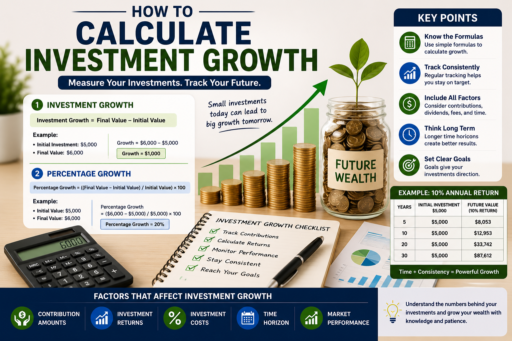
Understanding investment growth is one of the most important skills for building wealth. Investors who know how to measure and calculate investment performance can make more informed financial decisions, track progress toward goals, and evaluate the effectiveness of their strategies. Learning Calculate Investment Growth helps investors better understand how their money grows over time.
Whether you invest in stocks, index funds, ETFs, bonds, or retirement accounts, measuring growth allows you to see the impact of contributions, market performance, and compound returns.
In 2026, investors have access to many financial tools that simplify investment tracking, but understanding the basic calculations remains extremely valuable.
The concept of Calculate Investment Growth focuses on measuring returns, understanding percentages, tracking progress, and evaluating long-term wealth accumulation.
Why Calculating Investment Growth Matters
Investment growth calculations help investors:
- Measure performance
- Track financial goals
- Evaluate investment strategies
- Monitor portfolio progress
- Improve decision-making
Accurate calculations provide a clearer picture of financial progress.
Understanding Investment Growth
Investment growth refers to the increase in the value of an investment over a specific period.
Growth may come from:
- Capital appreciation
- Dividends
- Interest income
- Reinvested earnings
Understanding these sources helps investors evaluate total returns more effectively.
Basic Formula for Investment Growth
The simplest way to calculate investment growth is:
Investment Growth = Final Value − Initial Value
For example:
- Initial investment: $5,000
- Final value: $6,000
Investment growth equals $1,000.
Calculating Percentage Growth
Percentage growth helps investors compare performance more accurately.
Percentage Growth = ((Final Value − Initial Value) ÷ Initial Value) × 100
Example:
- Initial value: $5,000
- Final value: $6,000
The investment grew by 20%.
Understanding Compound Growth
Compound growth occurs when investment earnings generate additional earnings over time.
This process can significantly increase long-term wealth.
One reason investors focus on Calculate Investment Growth is to understand the impact of compounding.
Factors That Affect Investment Growth
Several factors influence investment performance.
- Contribution amounts
- Investment returns
- Investment costs
- Time horizon
- Market performance
Understanding these variables helps investors make better decisions.
Tracking Growth Over Multiple Years
Long-term investors often evaluate performance across several years rather than short periods.
Longer evaluation periods can provide a more accurate picture of investment success.
This approach helps reduce the influence of short-term market fluctuations.
Using Investment Tracking Tools
Many investors use spreadsheets, financial apps, and portfolio-tracking platforms to monitor investment growth.
Benefits include:
- Performance tracking
- Goal monitoring
- Portfolio analysis
- Progress reporting
Technology can simplify investment management significantly.
Comparing Different Investments
Growth calculations make it easier to compare investment opportunities.
Investors can evaluate:
- Stocks
- Index funds
- ETFs
- Bonds
- Retirement accounts
Consistent measurement helps identify strengths and weaknesses within a portfolio.
Evaluating Long-Term Investment Performance
Successful investors often focus on long-term performance rather than short-term market movements.
When evaluating growth, investors should consider:
- Total return
- Time invested
- Contribution amounts
- Investment costs
- Risk exposure
The Calculate Investment Growth approach emphasizes measuring progress over meaningful time periods.
Understanding Annual Growth Rates
Annual growth rates help investors compare investments over different periods.
Rather than focusing only on total returns, annualized performance provides a clearer view of how investments have performed each year.
This can make comparisons more accurate and meaningful.
Accounting for Additional Contributions
Many investors add money to their portfolios regularly.
When calculating growth, it is important to consider:
- Monthly contributions
- Dividend reinvestment
- Additional deposits
- Withdrawals
Ignoring these factors can create misleading performance calculations.
Common Investment Growth Calculation Mistakes
Many investors make errors when measuring performance.
Common mistakes include:
- Ignoring fees
- Overlooking dividends
- Focusing only on short-term results
- Comparing investments incorrectly
- Failing to track contributions
Understanding How to Calculate Investment Growth helps investors avoid these common mistakes.
Focus on Consistent Measurement
Using the same calculation methods over time improves accuracy and consistency.
Important areas to track include:
- Portfolio value
- Investment returns
- Contribution history
- Financial goals
Consistent measurement helps investors evaluate long-term progress more effectively.
Use Growth Calculations to Set Goals
Investment growth calculations can help investors create realistic financial goals.
Examples include:
- Retirement targets
- Net worth goals
- Investment milestones
- Financial independence objectives
Clear goals often improve motivation and financial discipline.
Combine Growth Analysis With Risk Management
While investment growth is important, risk should also be considered.
Investors should evaluate both:
- Portfolio performance
- Portfolio risk
Balancing growth and risk supports sustainable long-term investing success.
Use Trusted Financial Resources
Investors interested in learning more about investment performance can benefit from trusted educational resources. The Investor.gov website provides practical guidance on investing, portfolio management, diversification, and long-term financial planning.
Reliable financial education supports stronger investment decisions and improved financial outcomes.
Additional Resources for Investors
To strengthen your investing knowledge, consider reading Retirement Planning Basics for Beginners, Grow Your Net Worth Over Time, and Strategies for Passive Investing.
These resources provide practical strategies that complement the investment-growth concepts discussed in this guide.
The Benefits of Understanding Investment Growth
Learning Calculate Investment Growth can provide:
- Better financial decisions
- Improved portfolio tracking
- Greater investing confidence
- More accurate goal setting
- Stronger long-term financial outcomes
Investors who understand growth calculations often make more informed investment decisions.
Final Thoughts
The concept of Calculate Investment Growth demonstrates that measuring investment performance is an essential part of successful investing.
By understanding growth calculations, tracking contributions, evaluating performance consistently, and focusing on long-term goals, investors can improve their financial decision-making.
Remember that investment growth is not only about returns but also about maintaining discipline, consistency, and a long-term perspective.