
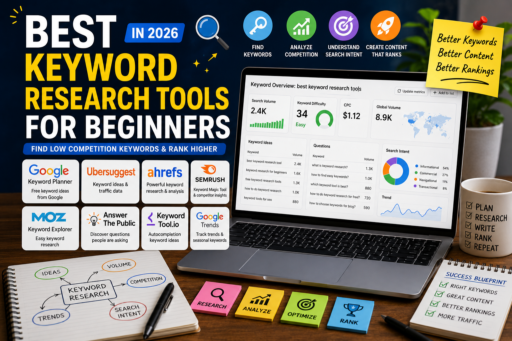
Keyword research remains one of the most important skills for anyone who wants to succeed with blogging, content marketing, affiliate marketing, YouTube, or search engine optimization. Before creating content, it’s essential to understand what people are searching for and how competitive those topics are. Fortunately, the Best Keyword Research Tools for Beginners make this process significantly easier.
Many beginners make the mistake of writing content based solely on personal assumptions. While passion and expertise are valuable, successful content creators also rely on data. Keyword research helps identify search demand, understand user intent, and uncover opportunities that can generate long-term organic traffic.
The good news is that keyword research no longer requires advanced technical knowledge. Modern SEO platforms provide user-friendly interfaces, keyword suggestions, search volume estimates, competition analysis, and content ideas that simplify the entire process.
Whether you’re starting a blog, building a niche website, launching a YouTube channel, or growing an online business, learning how to use keyword research tools can dramatically improve your results.
In this guide, we’ll explore the best keyword research tools for beginners in 2026, explain their strengths and weaknesses, and help you choose the right solution for your needs.
Why Keyword Research Matters
Keyword research is the foundation of successful SEO. Without it, content creators often target topics with little search demand or excessive competition.
Proper keyword research helps you:
- Discover topics people are actively searching for
- Understand search intent
- Find low-competition opportunities
- Increase organic traffic
- Create better content
- Improve search rankings
- Build a long-term content strategy
Instead of guessing what your audience wants, keyword research allows you to make informed decisions based on actual search behavior.
What Makes a Good Keyword Research Tool?
The best keyword research tools provide accurate data while remaining easy to use.
Important features include:
- Keyword suggestions
- Search volume estimates
- Keyword difficulty scores
- Competitor analysis
- Search trend tracking
- Content ideas
- SERP analysis
- Related keyword discovery
For beginners, simplicity is especially important. A platform may offer powerful features, but if the interface feels overwhelming, it becomes difficult to use effectively.
1. Google Keyword Planner
Among the Best Keyword Research Tools for Beginners, Google Keyword Planner remains one of the most accessible options available.
Originally designed for advertisers, the platform also provides valuable keyword insights for SEO and content planning.
Because the data comes directly from Google, many users consider it a reliable starting point for keyword research.
Key Features
- Keyword suggestions
- Search volume estimates
- Competition indicators
- Keyword forecasting
- Geographic targeting
Pros
- Free to use
- Direct Google data
- Beginner-friendly
- Large keyword database
Cons
- Limited SEO-specific metrics
- Broad search volume ranges
2. Ubersuggest
Among the Best Keyword Research Tools for Beginners, Ubersuggest continues to attract new bloggers because of its simple interface and affordable pricing.
The platform helps users discover keywords, analyze competitors, generate content ideas, and estimate traffic potential.
Unlike some advanced SEO platforms, Ubersuggest focuses heavily on usability.
Key Features
- Keyword suggestions
- Traffic estimates
- SEO difficulty scores
- Content ideas
- Competitor analysis
Pros
- Easy to understand
- Affordable pricing
- Good keyword discovery
- Helpful content suggestions
Cons
- Smaller database than enterprise tools
- Less advanced reporting
3. Ahrefs Keywords Explorer
Ahrefs remains one of the most powerful SEO tools available today.
Although it offers many advanced features, beginners can still benefit from its excellent keyword research capabilities.
Its database contains billions of keywords across multiple search engines and regions.
Key Features
- Keyword difficulty scores
- Search volume estimates
- Traffic potential analysis
- Competitor research
- SERP analysis
Pros
- Industry-leading database
- Accurate keyword metrics
- Excellent competitor insights
- Powerful reporting
Cons
- Premium pricing
- Can overwhelm new users
If you’re also exploring broader SEO platforms, check out our guide on Best SEO Tools for Bloggers in 2026.
4. Semrush Keyword Magic Tool
Semrush offers one of the largest keyword databases available in the SEO industry.
Its Keyword Magic Tool helps users discover keyword variations, questions, long-tail phrases, and search opportunities.
For beginners who want room to grow, Semrush provides a scalable solution that supports both simple and advanced research.
Key Features
- Massive keyword database
- Keyword grouping
- Question-based keywords
- Competitor analysis
- Search intent identification
Pros
- Comprehensive keyword data
- Excellent reporting
- Strong SEO ecosystem
- Detailed competitor analysis
Cons
- Premium pricing
- Learning curve
5. Google Trends
Google Trends is one of the most underrated keyword research tools available.
Instead of focusing primarily on search volume, it highlights search interest trends over time.
This helps content creators identify growing topics before they become highly competitive.
Key Features
- Trend analysis
- Seasonal keyword tracking
- Regional search interest
- Topic comparisons
- Emerging search trends
Pros
- Completely free
- Excellent trend analysis
- Simple interface
- Valuable for content planning
Cons
- No keyword difficulty metrics
- Limited SEO data
Understanding Search Intent
Keyword research is not just about finding high-volume keywords. Understanding search intent is equally important.
Search intent refers to the reason behind a user’s search query.
The four primary types include:
- Informational searches
- Navigational searches
- Commercial investigation searches
- Transactional searches
Content that matches search intent is more likely to rank successfully.
Why Long-Tail Keywords Matter
Many beginners target highly competitive keywords and become frustrated when they fail to rank.
Long-tail keywords often provide a better opportunity because they typically have lower competition and clearer user intent.
For example, targeting “SEO tools” may be extremely difficult. However, targeting “best keyword research tools for beginners” is often more achievable.
Long-tail keywords frequently generate highly targeted traffic that converts better than broad keywords.
Common Keyword Research Mistakes
Even with access to powerful tools, beginners often make several common mistakes.
- Targeting only high-volume keywords
- Ignoring search intent
- Overlooking long-tail opportunities
- Not analyzing competitors
- Choosing keywords that are too competitive
- Failing to update keyword research regularly
Avoiding these mistakes can significantly improve your chances of ranking successfully.
Bloggers interested in improving productivity may also enjoy reading Best AI Productivity Apps in 2026, which covers tools that can streamline content creation and workflow management.
6. KeywordTool.io
KeywordTool.io has become one of the most popular keyword research platforms for beginners because it generates a large number of keyword suggestions quickly.
The tool uses autocomplete data from multiple platforms, helping users discover search terms that may not appear in traditional keyword research tools.
This makes it especially useful for content creators looking for fresh ideas.
Key Features
- Autocomplete keyword suggestions
- Long-tail keyword discovery
- Multiple platform support
- Question-based keywords
- Content inspiration
Pros
- Simple interface
- Excellent keyword suggestions
- Useful for beginners
- Fast results
Cons
- Limited free version
- Advanced metrics require upgrades
7. AnswerThePublic
AnswerThePublic takes a unique approach to keyword research by focusing on questions people ask online.
Instead of simply showing keyword lists, it visualizes search queries in a way that helps content creators understand audience interests.
This approach makes it particularly valuable for bloggers looking to create helpful informational content.
Key Features
- Question-based keywords
- Visual keyword mapping
- Content idea generation
- Search intent insights
Pros
- Excellent content inspiration
- Easy to use
- Unique keyword discovery
- Strong search intent insights
Cons
- Limited SEO metrics
- Free searches are restricted
8. Moz Keyword Explorer
Moz Keyword Explorer remains a trusted solution for users who want reliable keyword data without overwhelming complexity.
The platform combines keyword suggestions, difficulty scores, and SERP analysis within a clean and beginner-friendly interface.
Key Features
- Keyword suggestions
- Priority scoring
- Search volume estimates
- SERP analysis
- Difficulty metrics
Pros
- Simple interface
- Reliable data
- Good educational resources
- Strong usability
Cons
- Smaller database than Ahrefs
- Limited free usage
Best Free Keyword Research Tools for Beginners
Not every beginner wants to invest in premium SEO software immediately.
Fortunately, several free tools provide enough data to build a successful content strategy.
Popular free options include:
- Google Keyword Planner
- Google Trends
- Google Search Console
- AnswerThePublic Free Version
- Bing Webmaster Tools
While premium tools offer deeper insights, these free options are often sufficient during the early stages of blogging.
How to Find Easy Keywords as a Beginner
One of the biggest mistakes beginners make is targeting extremely competitive keywords.
Instead, focus on keywords with:
- Clear search intent
- Lower competition
- Specific user needs
- Long-tail phrasing
- Reasonable search volume
This strategy often produces faster results because ranking becomes significantly easier.
As your website grows and gains authority, you can gradually target more competitive topics.
How Competitor Analysis Improves Keyword Research
Competitor analysis helps identify opportunities that may otherwise remain hidden.
Rather than starting from scratch, you can analyze successful websites in your niche and discover:
- Top-performing keywords
- Popular content topics
- Ranking opportunities
- Content gaps
- Traffic sources
Many keyword research tools include competitor analysis features that simplify this process.
The Relationship Between Keyword Research and SEO
Keyword research and SEO are closely connected.
Without proper keyword targeting, even well-written content may struggle to attract organic traffic.
Bloggers who want a deeper understanding of SEO platforms should also read our guide on How to Start a Blog That Makes Money.
Combining keyword research with strong on-page SEO significantly improves ranking potential.
How AI Is Transforming Keyword Research
Artificial intelligence is rapidly changing how keyword research works.
Modern SEO platforms can now identify keyword opportunities, predict search trends, analyze intent, and generate content recommendations automatically.
These capabilities allow bloggers to spend less time gathering data and more time creating valuable content.
Content creators interested in productivity tools may also find value in our article on Best AI Productivity Apps in 2026.
Keyword Research for Different Types of Content
Different content formats often require different keyword strategies.
Blog Posts
Focus on informational and long-tail keywords that answer specific questions.
Affiliate Content
Target commercial investigation keywords where users compare products and services.
YouTube Videos
Prioritize search phrases commonly used in video searches.
Local Businesses
Include geographic modifiers and location-specific terms.
Understanding these differences helps improve content performance across multiple platforms.
Tracking Keyword Performance
Keyword research doesn’t end after publishing content.
Successful bloggers regularly monitor rankings, traffic, and search visibility.
Important metrics include:
- Keyword positions
- Organic traffic
- Click-through rate
- Impressions
- User engagement
- Conversions
Tracking these metrics helps identify what’s working and where improvements are needed.
Using Keyword Research Beyond Blogging
Keyword research is useful for much more than blog content.
It can help improve:
- YouTube channels
- E-commerce stores
- Affiliate websites
- Social media content
- Email marketing campaigns
- Digital products
Because search behavior reflects audience interests, keyword data provides valuable insights for many types of online businesses.
Creating Downloadable Content With Keyword Data
Many successful bloggers turn keyword research into downloadable resources such as guides, checklists, templates, and eBooks.
When creating these resources, tools discussed in our article on Best Free PDF Tools Online in 2026 can help convert and organize content efficiently.
This strategy can improve user engagement while creating additional value for readers.
Common Keyword Research Myths
Several misconceptions continue to mislead beginners.
- Higher search volume always means better traffic.
- Keyword density guarantees rankings.
- Only premium tools produce results.
- Keyword research is a one-time task.
- Competition should always be avoided.
In reality, successful keyword research requires balancing search demand, competition, relevance, and search intent.
How to Choose the Right Tool
The best keyword research tool depends on your goals and budget.
- Choose Google Keyword Planner for free research.
- Choose Ubersuggest for affordability.
- Choose Ahrefs for advanced analysis.
- Choose Semrush for all-in-one marketing.
- Choose AnswerThePublic for content ideas.
- Choose Google Trends for trend monitoring.
Most bloggers eventually use multiple tools together because each platform provides different strengths.
Final Thoughts
Choosing the Best Keyword Research Tools for Beginners can dramatically improve your ability to create content that attracts organic traffic.
Whether you’re building a blog, growing a YouTube channel, launching an affiliate website, or expanding an online business, keyword research provides the foundation for long-term success.
Google Keyword Planner and Google Trends remain excellent free starting points, while Ubersuggest offers affordability and simplicity. Meanwhile, Ahrefs, Semrush, Moz, and KeywordTool.io provide powerful data for those seeking deeper insights.
By consistently researching keywords, understanding search intent, and creating valuable content around real user interests, beginners can build sustainable traffic and grow their online presence throughout 2026 and beyond.