
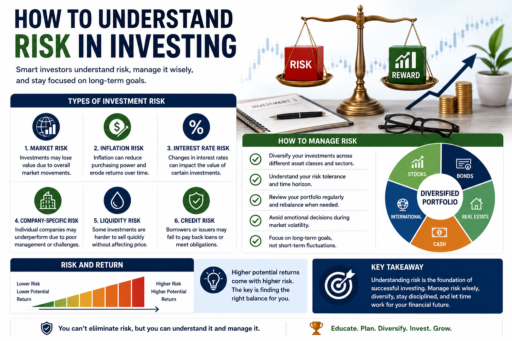
Every investment involves some level of risk. Whether investing in stocks, bonds, index funds, real estate, or other assets, understanding risk is essential for making informed financial decisions. Learning Understand Risk in Investing can help investors build appropriate portfolios, avoid common mistakes, and improve long-term financial outcomes.
Many beginners believe risk should be completely avoided. However, successful investing is often about understanding, managing, and balancing risk rather than eliminating it entirely.
In 2026, investors face various risks including market volatility, inflation, economic uncertainty, and changing interest rates. Understanding these risks can help investors make smarter decisions and maintain confidence during challenging periods.
The concept of Understand Risk in Investing focuses on education, diversification, risk management, and long-term planning.
What Is Investment Risk?
Investment risk refers to the possibility that an investment may not perform as expected.
Risk can involve:
- Temporary losses
- Permanent losses
- Lower-than-expected returns
- Market volatility
Understanding risk helps investors make realistic decisions and set appropriate expectations.
Why Understanding Risk Matters
Investors who understand risk are often better prepared for market fluctuations.
Benefits include:
- Improved decision-making
- Reduced emotional investing
- Better portfolio construction
- Greater financial confidence
- Long-term investing success
Risk awareness often leads to stronger investment discipline.
Risk Type #1: Market Risk
Market risk refers to the possibility that investments may decline because of overall market conditions.
Examples include:
- Economic recessions
- Market corrections
- Global events
- Investor sentiment changes
Market risk affects nearly all investors to some degree.
Risk Type #2: Inflation Risk
Inflation reduces purchasing power over time.
If investments fail to outpace inflation, real wealth may decline even when account balances increase.
This makes inflation an important consideration for long-term investors.
Risk Type #3: Interest Rate Risk
Interest rate changes can affect various investments, particularly bonds and income-producing assets.
Rising rates may reduce the value of certain investments, while falling rates can create different opportunities.
Understanding interest rate risk helps investors evaluate portfolio exposure.
Risk Type #4: Company-Specific Risk
Individual companies can experience problems regardless of overall market performance.
Examples include:
- Poor management decisions
- Declining sales
- Competitive pressures
- Financial difficulties
Diversification can help reduce company-specific risk.
One of the key lessons in Understand Risk in Investing is that diversification can help reduce company-specific risk.
Risk Type #5: Liquidity Risk
Liquidity risk refers to the difficulty of converting an investment into cash quickly.
Some investments are easier to sell than others.
Liquidity considerations become especially important during financial emergencies.
How Risk and Return Are Connected
Higher potential returns often involve higher levels of risk.
While risk does not guarantee better returns, investors typically expect greater potential rewards when accepting greater uncertainty.
Balancing risk and return is one of the most important investing skills.
The Importance of Diversification
One of the most effective lessons in Understand Risk in Investing is diversification.
Diversification helps spread investments across different assets and reduce dependence on a single investment.
Many investors use diversification as a core risk-management strategy.
How to Determine Your Risk Tolerance
Risk tolerance refers to your ability and willingness to handle investment fluctuations.
Factors that influence risk tolerance include:
- Age
- Income stability
- Investment experience
- Financial goals
- Time horizon
Understanding your risk tolerance is an important part of Understand Risk in Investing because it helps guide portfolio decisions.
Why Time Horizon Matters
Investment time horizon refers to how long money will remain invested.
Longer time horizons often allow investors to tolerate greater short-term volatility because they have more time to recover from market declines.
Short-term goals may require more conservative investment approaches.
Avoid Emotional Reactions to Risk
Many investors make poor decisions when markets become volatile.
Common emotional reactions include:
- Panic selling
- Chasing market trends
- Overreacting to news
- Frequent portfolio changes
The Understand Risk in Investing approach encourages discipline and long-term thinking rather than emotional decision-making.
Use Diversification to Manage Risk
Diversification remains one of the most effective risk-management tools available.
Diversified portfolios may include:
- Stocks
- Bonds
- Index funds
- International investments
- Cash reserves
Diversification helps reduce concentration risk and improve portfolio stability.
Review Risk Regularly
Risk levels can change as financial circumstances evolve.
Regular reviews may include:
- Portfolio allocation
- Financial goals
- Income changes
- Life events
Periodic reviews help ensure investments remain aligned with personal objectives.
Balance Risk and Reward
Successful investing often involves balancing growth opportunities with acceptable levels of risk.
Investors should avoid taking unnecessary risks while also recognizing that some risk is required for long-term growth.
The Understand Risk in Investing process focuses on finding an appropriate balance.
Think Long Term
Short-term market fluctuations are normal.
Long-term investors often benefit from:
- Market growth
- Compound returns
- Reduced emotional investing
- Greater financial discipline
Patience remains one of the most important investing skills.
Use Trusted Financial Resources
Investors interested in learning more about investment risk can benefit from trusted educational resources. The Investor.gov website provides practical guidance on investing, diversification, portfolio management, and risk awareness.
Reliable financial education supports stronger investment decisions and improved financial outcomes.
Additional Resources for Investors
To strengthen your investing knowledge, consider reading Build a Simple Investment Portfolio, Dividend Investing Tips for Beginners, and Mistakes New Investors Should Avoid.
These resources provide practical strategies that complement the risk-management principles discussed in this guide.
The Benefits of Understanding Investment Risk
Learning Understand Risk in Investing can provide:
- Better investment decisions
- Improved portfolio management
- Greater financial confidence
- Reduced emotional investing
- Stronger long-term outcomes
Risk awareness helps investors make more informed and disciplined financial decisions.
Final Thoughts
The concept of Understand Risk in Investing demonstrates that risk is a normal part of investing rather than something that should be completely avoided.
By understanding different types of risk, diversifying investments, maintaining a long-term perspective, and reviewing portfolios regularly, investors can improve their ability to navigate market uncertainty successfully.
Remember that successful investing often depends on managing risk wisely rather than attempting to eliminate it entirely.