
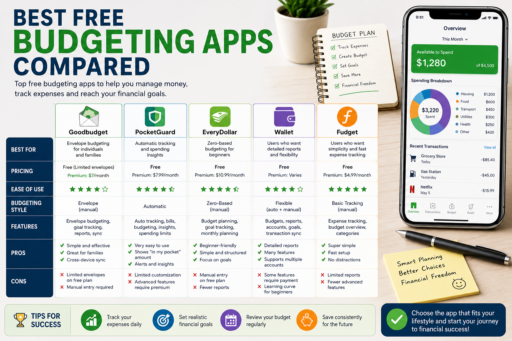
Managing money has become easier than ever thanks to budgeting applications. Instead of manually tracking expenses using notebooks or spreadsheets, modern budgeting apps can automatically organize transactions, monitor spending habits, and help users achieve financial goals. Choosing among the Best Free Budgeting Apps Compared can significantly improve your budgeting experience while saving time and effort.
In 2026, budgeting apps continue to evolve with advanced features such as expense categorization, savings tracking, spending alerts, and financial reporting. Many of these tools offer powerful free versions that provide everything most users need to improve their finances.
The challenge is deciding which app fits your goals and financial habits.
In this guide, we’ll compare some of the best free budgeting apps available today and explain their strengths, weaknesses, and ideal users.
Why Budgeting Apps Matter
Budgeting apps simplify financial management by providing visibility into spending behavior.
Benefits include:
- Automatic expense tracking
- Financial goal monitoring
- Budget creation
- Spending alerts
- Financial reports
- Improved money awareness
These tools make budgeting easier and more consistent.
What Makes a Good Budgeting App?
The best budgeting applications share several important characteristics.
Key features include:
- Ease of use
- Expense categorization
- Financial reporting
- Goal tracking
- Mobile accessibility
- Budget customization
A great budgeting app should help simplify financial management rather than complicate it.
1. Goodbudget
Goodbudget is one of the most popular free budgeting applications available.
The app uses a digital version of the traditional envelope budgeting method.
Advantages
- Simple interface
- Envelope budgeting system
- Goal tracking
- Cross-device synchronization
Disadvantages
- Limited free envelopes
- Manual transaction entry
Goodbudget works particularly well for users who prefer hands-on financial management.
2. PocketGuard
Among the Best Free Budgeting Apps Compared, PocketGuard stands out because of its simplicity.
The application focuses on helping users understand how much money remains available after bills and savings goals.
Advantages
- Easy to understand
- Automatic expense tracking
- Spending analysis
- Financial insights
Disadvantages
- Advanced features require premium plans
- Limited customization
3. EveryDollar
EveryDollar follows a zero-based budgeting approach.
This budgeting system assigns every dollar a specific purpose.
Advantages
- Simple budgeting process
- Goal-focused structure
- Beginner-friendly interface
Disadvantages
- Manual entry on free plans
- Fewer advanced analytics features
EveryDollar is ideal for users who prefer structured budgeting systems.
4. Wallet
Wallet has gained popularity due to its comprehensive budgeting features and clean design.
The application provides:
- Budget tracking
- Expense categorization
- Financial reports
- Goal management
Advantages
- Detailed reports
- Attractive interface
- Multiple budgeting options
Disadvantages
- Some features require payment
- Learning curve for beginners
5. Fudget
Fudget takes a different approach compared to many budgeting apps.
Instead of offering complex analytics, it focuses on simplicity.
Advantages
- Extremely simple interface
- Fast setup
- Minimal distractions
Disadvantages
- Limited reporting
- Fewer advanced features
Fudget works best for users who want straightforward expense tracking.
How Budgeting Apps Improve Financial Awareness
One of the biggest advantages of budgeting apps is visibility.
Many people underestimate their spending because they do not track expenses consistently.
Budgeting apps automatically reveal:
- Spending patterns
- Category totals
- Monthly trends
- Savings progress
This information helps users make smarter financial decisions.
Budgeting Apps and Expense Tracking
Expense tracking remains one of the most valuable budgeting features.
If you’re interested in improving spending awareness, you may also enjoy our guide on Best Ways to Track Your Daily Expenses.
Combining budgeting tools with consistent expense tracking often produces the best financial results.
Choosing the Right App
The best budgeting application depends on your financial personality.
- Prefer simplicity? Try Fudget.
- Like envelope budgeting? Choose Goodbudget.
- Want structured budgeting? Use EveryDollar.
- Need detailed reporting? Consider Wallet.
- Want automation? PocketGuard may be ideal.
There is no perfect app for everyone.
The best choice is the one you will use consistently.
Comparing the Best Free Budgeting Apps
When evaluating the Best Free Budgeting Apps Compared, it helps to understand which app excels in specific areas.
| App | Best For | Ease of Use | Budgeting Style |
|---|---|---|---|
| Goodbudget | Envelope Budgeting | High | Manual |
| PocketGuard | Automation | High | Automatic |
| EveryDollar | Zero-Based Budgeting | High | Structured |
| Wallet | Detailed Reports | Medium | Flexible |
| Fudget | Simplicity | Very High | Basic Tracking |
Each application serves different financial needs and preferences.
Budgeting Apps for Beginners
New users often benefit from simple applications rather than feature-heavy platforms.
For beginners, the best choices are usually:
- Fudget
- PocketGuard
- EveryDollar
These apps provide straightforward budgeting experiences without overwhelming complexity.
Budgeting Apps for Families
Families often require more comprehensive budgeting systems.
Features that help households include:
- Shared budgeting
- Multiple expense categories
- Goal tracking
- Spending reports
- Household financial planning
Goodbudget is particularly popular among families because of its shared budgeting capabilities.
If you’re managing household finances, you may also enjoy our guide on Best Budgeting Tools for Families.
How Budgeting Apps Help You Save More Money
Budgeting apps do more than organize expenses.
They also help users identify opportunities to save.
Common benefits include:
- Reducing overspending
- Identifying spending leaks
- Tracking financial goals
- Building savings habits
These improvements can have a significant impact over time.
Common Budgeting App Mistakes
Even the best budgeting tools cannot help if they are used incorrectly.
Common mistakes include:
- Not updating information
- Ignoring reports
- Failing to review spending
- Using overly complicated setups
- Abandoning the app after a few weeks
Consistency remains the key to success.
Security and Privacy Considerations
Many people wonder whether budgeting applications are safe.
Before using any financial tool, consider:
- Data encryption
- Privacy policies
- Two-factor authentication
- Company reputation
- Account security features
Choosing reputable applications helps reduce security concerns.
Manual vs Automatic Budgeting Apps
Budgeting applications generally fall into two categories.
Manual Apps
- Greater awareness
- More control
- Requires effort
Automatic Apps
- Less effort
- Faster tracking
- Potentially less engagement
The best option depends on personal preference.
How Budgeting Apps Support Financial Goals
Most modern budgeting applications allow users to create and monitor financial goals.
Examples include:
- Emergency funds
- Vacation savings
- Debt reduction
- Investment goals
- Major purchases
Tracking progress can increase motivation and improve financial discipline.
Using Budgeting Apps Alongside Monthly Budgets
Budgeting apps work especially well when combined with a structured monthly budget.
If you’re creating a spending plan, you may also enjoy our guide on How to Create a Monthly Budget That Actually Works.
Combining budgeting systems with digital tools often produces the strongest financial results.
Why Financial Awareness Matters
Financial awareness is one of the biggest predictors of budgeting success.
People who regularly monitor spending tend to:
- Save more money
- Reduce debt faster
- Avoid financial surprises
- Reach goals sooner
Budgeting applications make financial awareness easier to maintain.
Learning From Spending Reports
Reports generated by budgeting apps often reveal surprising spending patterns.
You may discover:
- Overspending categories
- Unused subscriptions
- Seasonal spending habits
- Unexpected financial leaks
This information helps improve future financial decisions.
Trusted Financial Resources
People interested in improving budgeting skills can benefit from reliable financial education resources. The Consumer Financial Protection Bureau provides practical guidance on budgeting, saving, and money management.
Combining financial education with budgeting apps can significantly improve financial outcomes.
Final Thoughts
The Best Free Budgeting Apps Compared offer powerful tools for managing money, tracking expenses, building savings, and improving financial awareness.
Whether you prefer the simplicity of Fudget, the envelope system of Goodbudget, the automation of PocketGuard, the structure of EveryDollar, or the detailed reports provided by Wallet, there is a budgeting app that fits your needs.
The most important factor is consistency. Choose an application that matches your lifestyle, use it regularly, review your spending habits, and allow the data to guide smarter financial decisions.
Over time, even small improvements in budgeting can create significant financial progress and help you achieve your long-term goals.