
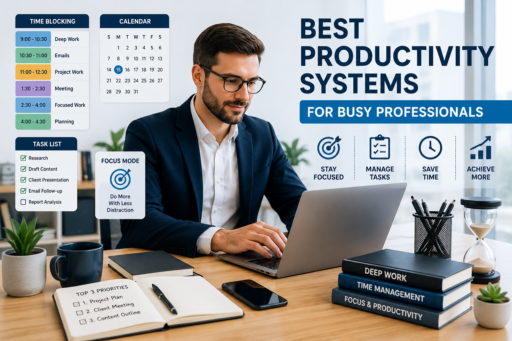
Productivity has become one of the most valuable skills in today’s fast-paced world. Many busy professionals are looking for the best productivity systems for busy professionals to help manage their workload efficiently. Professionals are expected to manage meetings, answer emails, complete projects, learn new skills, and still maintain a healthy work-life balance. Unfortunately, working longer hours does not always produce better results. Many busy professionals discover that despite spending an entire day working, they still finish with important tasks left undone.
The real difference between highly productive people and those who constantly feel overwhelmed is not intelligence or motivation. It is having a reliable productivity system. Instead of making hundreds of decisions every day about what to work on next, a productivity system provides structure, reduces mental fatigue, and helps you focus on the tasks that create the greatest value.
The best productivity systems for busy professionals are not about filling every minute with work. They are designed to help you complete meaningful tasks more efficiently while reducing stress and preventing burnout. A good system creates consistency, allowing you to make steady progress even during hectic weeks.
In this guide, you’ll discover practical productivity systems that professionals around the world use to stay organized, manage priorities, and accomplish more without sacrificing their personal lives.
Why Productivity Systems Matter
Many professionals rely entirely on memory or react to whatever appears in their inbox first. While this approach might seem flexible, it usually creates constant interruptions and poor prioritization.
A structured productivity system offers several important advantages:
- Reduces decision fatigue
- Improves daily focus
- Prevents forgotten tasks
- Creates consistent routines
- Makes large projects easier to manage
- Reduces unnecessary stress
- Helps balance work and personal responsibilities
Instead of wondering what to do next, you simply follow your system.
Focus on Systems Instead of Motivation
Motivation naturally rises and falls. Some mornings you feel energized, while other days even simple tasks seem difficult. If your productivity depends entirely on motivation, your results will also fluctuate.
Successful professionals depend on habits and systems rather than temporary feelings. Their calendars, task lists, review sessions, and planning routines continue working even when motivation is low.
This is one of the biggest reasons the best productivity systems for busy professionals consistently outperform random bursts of effort.
The Time Blocking System
Time blocking is one of the simplest yet most effective productivity methods available.
Instead of keeping a long to-do list, you schedule specific work directly into your calendar. Every important activity receives its own dedicated time block.
For example:
- 8:00–9:00 Morning planning
- 9:00–11:00 Deep project work
- 11:00–11:30 Email responses
- 1:00–2:30 Client meetings
- 3:00–4:00 Administrative tasks
Because every task already has a scheduled time, you spend less energy deciding what to work on next.
Many professionals find that time blocking also reduces procrastination because each task has a clearly defined starting point.
Deep Work Sessions
Constant interruptions destroy productivity.
Checking messages every few minutes may feel productive, but frequent context switching dramatically reduces concentration.
Deep work sessions eliminate these distractions by creating uninterrupted periods of focused work.
During a deep work session:
- Silence notifications.
- Close unnecessary browser tabs.
- Put your phone away.
- Focus on only one important task.
- Avoid multitasking completely.
Even one or two deep work sessions each day can significantly increase the amount of meaningful work completed.
The Daily Priority System
Busy professionals often create enormous task lists that are impossible to finish.
Instead of trying to complete twenty different activities, identify only three high-impact priorities every morning.
Ask yourself:
- What task creates the greatest progress?
- What absolutely must be completed today?
- Which activity delivers the highest value?
Completing three meaningful priorities often produces far better results than finishing fifteen minor tasks.
The Weekly Planning Routine
Daily planning is helpful, but weekly planning provides a much bigger picture.
Set aside 20 to 30 minutes each week to review upcoming responsibilities.
During your weekly review:
- Check project deadlines.
- Schedule important meetings.
- Organize your calendar.
- Remove outdated tasks.
- Add new priorities.
- Plan focused work sessions.
This routine prevents surprises and makes each workday feel more intentional.
The Two-Minute Rule
One of the easiest productivity habits comes from David Allen’s well-known productivity philosophy.
If a task takes less than two minutes, complete it immediately instead of adding it to your task list.
Examples include:
- Replying to a short email
- Filing a document
- Scheduling an appointment
- Sending a quick confirmation
- Updating a calendar event
Small tasks accumulate surprisingly quickly. Handling them immediately prevents unnecessary clutter in your workload. This simple habit is one of the best productivity systems for busy professionals because it keeps your task list organized, reduces mental overload, and allows you to stay focused on higher-priority work throughout the day.
Organize Tasks by Energy Levels
Not every task requires the same amount of mental effort.
Creative writing, strategic planning, financial analysis, and problem-solving require high concentration.
Administrative work, document filing, and routine emails require much less mental energy.
A smarter productivity system matches tasks with your natural energy levels.
For example:
Morning:
- Strategy
- Writing
- Analysis
- Project planning
Afternoon:
- Meetings
- Administrative work
- Follow-ups
Evening:
- Learning
- Reading
- Reviewing tomorrow’s schedule
Working with your energy instead of against it often increases productivity without requiring additional hours.
Batch Similar Tasks Together
Switching between unrelated tasks wastes valuable mental energy.
Task batching groups similar activities together.
Examples include:
- Answering all emails at specific times
- Making phone calls consecutively
- Scheduling meetings together
- Paying bills in one session
- Reviewing reports at once
Because your brain remains in the same mode, you work more efficiently.
Limit Daily Meetings
Meetings consume a large portion of many professionals’ schedules.
Before accepting another meeting, ask:
- Is this meeting necessary?
- Can this be handled by email?
- Could a shared document solve the problem?
- Does everyone invited need to attend?
Reducing unnecessary meetings creates more time for meaningful work.
Create Repeatable Workflows
Professionals often repeat the same processes every week.
Instead of reinventing every workflow, build reusable systems.
Examples include:
- Email templates
- Meeting agendas
- Project checklists
- Client onboarding documents
- Weekly reporting templates
Standardized workflows reduce mistakes while saving significant amounts of time over the long term. In fact, they are considered one of the best productivity systems for busy professionals because they improve consistency, reduce repetitive decision-making, and allow teams to complete recurring tasks more efficiently.
Eliminate Decision Fatigue
Every small decision consumes mental energy.
Highly productive professionals simplify routine decisions whenever possible.
They often standardize:
- Morning routines
- Workout schedules
- Meal planning
- Calendar reviews
- Task organization
- File naming systems
Saving mental energy for important decisions improves overall performance throughout the day.
Review Progress Every Evening
One simple habit separates organized professionals from constantly overwhelmed workers.
Spend five to ten minutes reviewing your day before finishing work.
Ask yourself:
- What did I accomplish today?
- Which tasks remain unfinished?
- What should become tomorrow’s priorities?
- Are there any deadlines approaching?
Ending each day with clarity makes starting the next day much easier and reduces overnight stress.
Internal Link Opportunity: Best AI Productivity Apps in 2026
Avoid Multitasking
Many people believe multitasking increases efficiency.
Research and real-world experience suggest the opposite.
Switching repeatedly between emails, spreadsheets, meetings, and messaging apps creates constant interruptions that reduce concentration and increase mistakes.
Focusing on one important activity until completion usually produces higher-quality work in less time.
Professionals who master single-tasking often feel calmer while completing more meaningful work than those constantly juggling multiple responsibilities.
Build a Distraction-Free Work Environment
Your productivity system is only as effective as the environment where you use it. Even the best planning methods can fail if you’re constantly interrupted by notifications, social media, or unnecessary distractions.
Start by organizing your workspace. Keep only the tools you need for your current task on your desk. A clutter-free environment helps reduce mental clutter as well.
Consider these simple improvements:
- Turn off non-essential notifications.
- Use noise-canceling headphones if you work in a busy office.
- Keep your phone out of reach during deep work sessions.
- Close browser tabs that are unrelated to your current task.
- Keep water and frequently used supplies nearby to avoid unnecessary interruptions.
Small environmental changes can significantly improve concentration over time.
Learn to Say No
One of the biggest productivity challenges for busy professionals isn’t poor organization—it’s taking on too many commitments.
Every meeting you accept, every extra project you volunteer for, and every unnecessary request you agree to reduces the time available for your highest priorities.
Before saying yes, ask yourself:
- Does this align with my current goals?
- Is this the best use of my time?
- Can someone else handle this task?
- Will accepting this create unnecessary stress later?
Learning to say no respectfully is an important part of protecting your schedule and maintaining consistent productivity. This habit is one of the best productivity systems for busy professionals, helping you focus on high-value work instead of becoming overwhelmed by unnecessary commitments.
Use Technology as a Support Tool
Technology should simplify your workflow, not complicate it.
Many professionals install dozens of productivity apps but rarely use them consistently. Instead of chasing every new tool, choose a small number of reliable applications that fit your workflow.
Useful categories include:
- Task management
- Calendar scheduling
- Note-taking
- Cloud storage
- Team collaboration
- Time tracking
Consistency matters far more than using the newest software.
Internal Link Opportunity: Best Cloud Storage Apps for Secure Backups
Track Where Your Time Goes
Many people underestimate how much time they spend switching between tasks, checking emails, or browsing websites.
For one week, keep track of how you actually spend your workday.
You may discover that:
- Meetings take longer than expected.
- Email consumes several hours daily.
- Social media interruptions happen more often than you realized.
- Administrative work replaces important project work.
Once you understand where your time goes, you can make smarter scheduling decisions.
Automate Repetitive Tasks
Automation saves time by eliminating repetitive manual work.
Examples include:
- Automatically organizing emails into folders.
- Scheduling recurring calendar events.
- Using templates for reports.
- Automating invoice generation.
- Backing up files automatically.
- Synchronizing tasks across devices.
Even saving five minutes each day adds up to many hours over the course of a year.
Keep Your Task List Manageable
Long task lists often become overwhelming.
Instead of recording every possible idea in your main task list, organize tasks into categories such as:
- Today
- This Week
- Waiting
- Someday
- Completed
This structure makes it easier to focus only on what’s currently important while keeping future ideas safely stored.
Build Strong Morning and Evening Routines
Your routines create momentum.
A productive morning might include:
- Reviewing your calendar.
- Identifying three priorities.
- Checking urgent messages.
- Beginning your first deep work session.
An evening routine could include:
- Reviewing completed work.
- Preparing tomorrow’s schedule.
- Clearing your workspace.
- Updating project progress.
These simple habits reduce decision-making and create consistency throughout the week.
Measure Results Instead of Busyness
Being busy does not always mean being productive.
A calendar full of meetings and a constantly active inbox can create the illusion of progress without producing meaningful results.
Instead of asking:
“How busy was I today?”
Ask:
- What important work did I finish?
- Did I move my biggest project forward?
- Did I complete my daily priorities?
- Did my work create measurable value?
Focusing on outcomes encourages smarter work instead of simply working longer hours. This mindset is one of the best productivity systems for busy professionals, helping you prioritize meaningful results over constant busyness and improve long-term performance.
Continuously Improve Your Productivity System
No productivity system remains perfect forever.
Your responsibilities, career, technology, and personal life will continue changing. Review your system regularly and make adjustments when necessary.
Ask yourself every month:
- Which habits are working well?
- Which routines feel unnecessary?
- What wastes the most time?
- What could be automated?
- Which meetings can be reduced?
- Are my priorities still aligned with my goals?
Small improvements made consistently often produce significant long-term gains.
No productivity system remains perfect forever. Your responsibilities, career, technology, and personal life will continue changing. Review your system regularly and make adjustments when necessary. You can also explore evidence-based productivity strategies from Harvard Business Review to discover additional techniques for improving focus, decision-making, and long-term performance.
Common Productivity Mistakes
Even experienced professionals make mistakes that reduce efficiency.
Some of the most common include:
- Trying to multitask constantly.
- Planning too many tasks for one day.
- Checking email every few minutes.
- Never reviewing completed work.
- Ignoring breaks.
- Working without clear priorities.
- Constantly switching productivity apps.
- Saying yes to every request.
Recognizing these habits is the first step toward building a stronger and more sustainable productivity system.
Building a System That Fits Your Lifestyle
There is no universal productivity method that works for everyone.
Some professionals thrive with highly detailed schedules, while others prefer flexible planning with broader priorities.
Experiment with different approaches and keep the parts that genuinely improve your workflow.
Your productivity system should support your life—not control it.
If maintaining a complicated system feels exhausting, simplify it until it becomes easy to follow consistently.
Final Thoughts
The best productivity systems for busy professionals are built around consistency rather than perfection. You don’t need an expensive app, an advanced planner, or a complicated framework to become more productive. What you need is a reliable system that helps you focus on meaningful work every day.
Start by choosing one or two productivity techniques from this guide, such as time blocking, weekly planning, or deep work sessions. Practice them consistently for several weeks before adding something new. Gradually, these habits will become part of your routine, making it easier to stay organized even during your busiest periods.
Remember that productivity isn’t about doing more tasks—it’s about completing the right tasks at the right time. By creating systems that reduce distractions, simplify decision-making, and encourage regular reviews, you’ll not only accomplish more but also enjoy a healthier balance between your professional and personal life.
Internal Link Opportunity: Best Note-Taking Apps for Productivity
Internal Link Opportunity: Best To-Do List Apps for Busy Professionals
For additional evidence-based productivity techniques and workplace efficiency research, you can naturally link to Harvard Business Review in the section discussing continuous improvement and effective work habits.