
If you are searching for the best monthly budget template for beginners, you are already taking one of the most important steps toward financial stability. Managing money does not need to be complicated. In fact, with the right template, budgeting can become a simple habit that gives you clarity, confidence, and peace of mind.
Many people earn a steady income but still feel stressed about money. They pay bills, buy groceries, and cover daily expenses, yet they are not sure where the rest of their paycheck goes. As a result, saving money feels difficult and long-term financial goals seem out of reach.
Fortunately, a monthly budget template solves this problem. It provides a clear structure for tracking your income, expenses, savings, and debt payments in one place. More importantly, it helps you assign every dollar a purpose so that your money works for you instead of disappearing without a plan.
In this complete guide, you will learn what makes the best monthly budget template for beginners, how to build one step by step, and how to use it consistently to improve your financial life in 2026 and beyond.
If you want to create a full money management strategy, read Simple Personal Finance System That Actually Works (2026). To protect your online transactions, see Protect Your Online Payments From Fraud (2026 Guide). To store important documents safely, check Secure Your Files on Cloud Storage (Google Drive & More) 2026. In addition, keep all your financial accounts secure with Manage Passwords Securely Without Forgetting Them (2026).
Why Every Beginner Needs a Budget Template
When people hear the word “budget,” they often imagine complicated spreadsheets and strict rules. However, budgeting is simply a plan for your money. It tells you how much you earn, how much you spend, and how much you save each month.
Without a budget, it is easy to overspend and difficult to make progress. On the other hand, with a budget template, you gain immediate visibility into your finances.
- You know exactly where your money goes.
- You can stop living paycheck to paycheck.
- You build savings automatically.
- You reduce debt more quickly.
- You feel less financial stress.
- You make smarter money decisions.
According to the Consumer Financial Protection Bureau, budgeting is one of the most effective ways to take control of your finances and prepare for future goals.
What Is a Monthly Budget Template?
A monthly budget template is a worksheet that organizes your financial information for one month. It includes categories for income, fixed expenses, variable expenses, savings, and debt payments.
Rather than guessing whether you can afford a purchase, you simply consult your budget. Consequently, your spending becomes more intentional and your financial goals become easier to achieve.
Main Sections of the Best Monthly Budget Template for Beginners
1. Income
This section includes all money you receive during the month.
- Salary
- Freelance income
- Business income
- Investment income
- Other income sources
2. Fixed Expenses
These are bills that stay relatively consistent every month.
- Rent or mortgage
- Utilities
- Internet
- Phone
- Insurance
- Subscriptions
3. Variable Expenses
These categories change from month to month.
- Groceries
- Transportation
- Dining out
- Entertainment
- Shopping
4. Savings
This section helps you pay yourself first.
- Emergency fund
- Retirement savings
- Travel fund
- Major purchases
5. Debt Payments
Include all loan and credit card payments.
- Credit cards
- Personal loans
- Student loans
- Car loans
6. Remaining Balance
This final number shows how much money is left after all planned spending and saving.
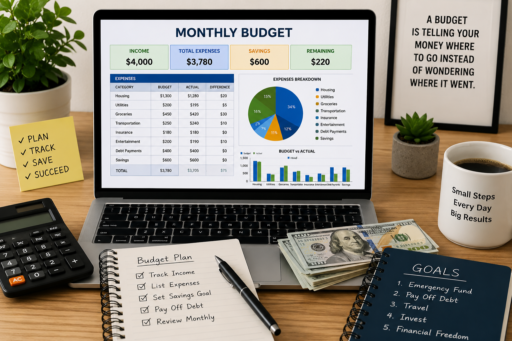
Example of the Best Monthly Budget Template for Beginners
| Category | Amount |
|---|---|
| Total Income | $4,000 |
| Housing | $1,300 |
| Utilities | $200 |
| Groceries | $450 |
| Transportation | $250 |
| Insurance | $180 |
| Entertainment | $200 |
| Debt Payments | $400 |
| Savings | $600 |
| Remaining Balance | $220 |
How to Build Your First Monthly Budget
Step 1: Calculate Your Total Income
Add all dependable income sources you expect this month.
Step 2: List Essential Expenses
Start with housing, utilities, groceries, and transportation.
Step 3: Estimate Flexible Spending
Set limits for categories like entertainment and dining out.
Step 4: Allocate Savings
Decide how much you want to save before spending on non-essentials.
Step 5: Include Debt Payments
Plan all required and extra debt payments.
Step 6: Review Your Remaining Balance
Make sure income covers all expenses and goals.
Step 7: Track Actual Spending
Update your template weekly and compare planned versus actual expenses.
The 50/30/20 Budget Rule
One of the easiest budgeting methods for beginners is the 50/30/20 rule.
- 50% for needs
- 30% for wants
- 20% for savings and debt repayment
This method is flexible and simple to apply using any budget template.
Zero-Based Budgeting
Zero-based budgeting assigns every dollar a specific purpose. By the end of the planning process, your remaining balance equals zero. This does not mean you have no money left. Instead, it means every dollar has been assigned to spending, saving, or debt reduction.
Pay Yourself First
Another highly effective strategy is to move money to savings immediately after receiving income. This approach ensures that saving becomes a priority rather than an afterthought.
Why Google Sheets Is Perfect for Budgeting
Many beginners use Google Sheets because it is free, accessible from any device, and automatically saves your work in the cloud. As a result, you can update your budget anytime and anywhere.
Best Budget Categories for Beginners
Choosing the right categories is essential when using the best monthly budget template for beginners. Well-organized categories make your budget easier to understand and much more effective over time.
- Housing
- Utilities
- Groceries
- Transportation
- Insurance
- Healthcare
- Debt Payments
- Savings
- Investments
- Entertainment
- Dining Out
- Personal Care
- Subscriptions
- Gifts
- Travel
- Miscellaneous
How to Stick to Your Budget Every Month
Creating a budget is only the first step. More importantly, you need to use it consistently. Fortunately, a few simple habits can make budgeting much easier.
1. Review Your Budget Weekly
Spend 10 to 15 minutes each week updating your numbers. This prevents surprises and keeps your spending under control.
2. Automate Your Savings
Set up automatic transfers to your savings account immediately after payday.
3. Track Every Expense
Even small purchases matter. Over time, they can significantly affect your budget.
4. Adjust as Needed
Your budget should evolve with your circumstances. Therefore, make changes whenever your income or expenses change.
5. Celebrate Progress
Every month you follow your budget is a financial victory worth recognizing.
Common Budgeting Mistakes Beginners Make
- Setting unrealistic spending limits
- Ignoring irregular expenses
- Not tracking actual spending
- Forgetting annual subscriptions
- Giving up after one mistake
- Not reviewing the budget regularly
How to Budget with Irregular Income
If your income changes from month to month, use your lowest expected income as the foundation of your budget. Then, when you earn more than expected, allocate the extra money to savings, investments, or debt reduction.
Best Monthly Budget Template for Families
Families can use the same template while adding categories such as childcare, school supplies, medical expenses, and home maintenance. In many cases, a family budget creates greater financial harmony and reduces stress.
Best Monthly Budget Template for Students
Students can simplify the template by focusing on tuition, books, transportation, groceries, and part-time income. Learning to budget early creates a strong financial foundation for life.
Best Monthly Budget Template for Freelancers
Freelancers should include categories for taxes, business expenses, and a larger emergency fund. Since income may fluctuate, budgeting becomes even more important.
How Budgeting Helps You Build an Emergency Fund
One of the biggest benefits of using the best monthly budget template for beginners is the ability to save consistently for emergencies.
Start with a goal of $1,000. Then gradually build three to six months of living expenses. As a result, unexpected costs become far less stressful.
How Budgeting Helps You Pay Off Debt Faster
A detailed budget reveals areas where you can cut expenses and redirect money toward debt repayment. Over time, this can save thousands of dollars in interest.
Psychological Benefits of Budgeting
Budgeting does more than improve your bank account. It also improves your mental well-being.
- Reduces anxiety
- Increases confidence
- Provides a sense of control
- Improves decision-making
- Creates peace of mind
Digital Security and Your Budget
Modern budgeting often involves online banking, cloud spreadsheets, and password managers. Therefore, protecting your financial information is essential.
To strengthen your overall financial system, read:
- Protect Your Online Payments From Fraud (2026 Guide)
- Secure Your Files on Cloud Storage (Google Drive & More) 2026
- Manage Passwords Securely Without Forgetting Them (2026)
Best Budgeting Apps for Beginners
- YNAB (You Need A Budget)
- EveryDollar
- Monarch Money
- PocketGuard
- Goodbudget
Paper Budget vs Digital Budget
Some people prefer writing by hand, while others prefer spreadsheets and apps. Ultimately, the best system is the one you will use consistently.
How to Review Your Budget at the End of the Month
At month-end, compare your planned amounts with actual spending.
- Which categories exceeded expectations?
- Where did you save money?
- How much did you add to savings?
- What improvements can you make next month?
30-Day Beginner Budget Challenge
- Create your template.
- Track every expense.
- Review weekly.
- Reduce one unnecessary expense.
- Transfer money to savings.
- Evaluate and improve.
Frequently Asked Questions
What is the best monthly budget template for beginners?
The best template is simple, flexible, and easy to update consistently.
Should I use Excel or Google Sheets?
Both work well, but Google Sheets is free and accessible from any device.
How often should I update my budget?
Weekly updates are ideal for staying on track.
What if I overspend?
Adjust your categories and continue. One mistake does not ruin your progress.
How much should I save each month?
Any consistent amount is beneficial, even if you start small.
Final Thoughts
The best monthly budget template for beginners is not the most complicated spreadsheet. Instead, it is the one you will actually use month after month.
When you know exactly where your money goes, everything changes. You feel more confident, reduce financial stress, and steadily build wealth.
Start today with a simple template. Then, refine it over time as your income, expenses, and goals evolve.
Remember, budgeting is not about restricting your life. Rather, it is about creating freedom, clarity, and control over every dollar you earn.