
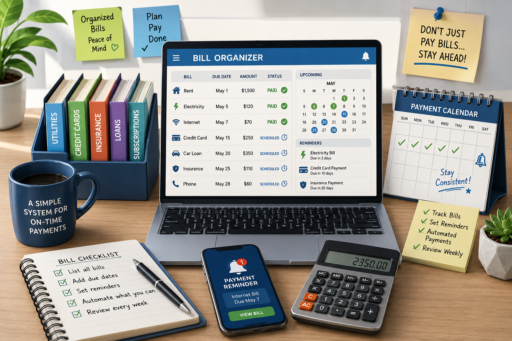
If you want to organize your bills and never miss a payment, you are building one of the most valuable financial habits possible. A reliable bill payment system reduces stress, protects your credit score, and helps you stay in full control of your money.
Many people miss payments not because they lack money, but because they lack a simple system. As a result, they may face late fees, interest charges, and unnecessary financial anxiety. Fortunately, with the right routine, you can organize every bill and ensure payments are made on time.
In this complete guide, you will learn exactly how to organize your bills and never miss a payment using calendars, automation, budgeting tools, and practical money habits that work in 2026 and beyond.
To strengthen your overall financial system, you may also want to read Build a Money Routine That Sticks (2026 Guide), How to Automate Your Savings Step by Step (2026 Guide), Best Monthly Budget Template for Beginners (2026), and 50 Money Habits That Improve Your Finances in 2026.
Why Organizing Bills Matters
Keeping your bills organized does far more than prevent missed due dates. In fact, it improves nearly every area of your financial life.
- Avoids late fees
- Protects your credit score
- Reduces stress
- Improves cash flow planning
- Strengthens budgeting accuracy
- Creates financial confidence
According to the Consumer Financial Protection Bureau, maintaining a structured payment system is one of the most effective ways to stay financially organized.
Common Reasons People Miss Payments
- Forgetting due dates
- Paper bills piling up
- Lack of automation
- Poor cash flow planning
- Too many accounts to track
- Irregular income
Step 1: Make a Complete List of Your Bills
Start by listing every recurring bill, including rent, utilities, internet, insurance, subscriptions, loans, and credit cards.
Step 2: Record Due Dates and Minimum Payments
Document the due date, payment amount, and payment method for each bill.
Step 3: Create a Bill Payment Calendar
Use a digital calendar or spreadsheet to track all payment dates.
Step 4: Set Payment Reminders
Schedule alerts several days before each due date.
Step 5: Use Automatic Payments
Automating essential bills reduces the risk of forgetting.
Step 6: Keep a Dedicated Bill Checking Account
Separating bill money from discretionary spending improves control.
Step 7: Build a Monthly Bill Tracker
A bill tracker provides a clear visual record of paid and unpaid bills.
Step 8: Review Bills Weekly
Regular check-ins help you catch problems early.
Step 9: Simplify Due Dates
When possible, request due date changes so bills cluster around payday.
Step 10: Include Bills in Your Budget
Your budget should account for every fixed and recurring expense.
Types of Bills to Track
- Housing
- Utilities
- Insurance
- Debt payments
- Subscriptions
- Child-related expenses
- Taxes
Sample Monthly Bill Tracker
| Bill | Due Date | Amount | Status |
|---|---|---|---|
| Rent | 1st | $1,500 | Paid |
| Internet | 5th | $70 | Pending |
| Credit Card | 15th | $150 | Pending |
| Insurance | 22nd | $120 | Pending |
How a Bill System Reduces Financial Stress
When every payment has a clear place in your routine, money management becomes much more predictable and less overwhelming.
How Automation Prevents Missed Payments
Automatic payments and reminders create a reliable safety net.
How to Organize Bills with Irregular Income
If your income changes from month to month, you can still organize your bills and never miss a payment by prioritizing essential expenses and building a cash buffer in your checking account.
How Families Can Manage Bills Together
Families benefit when both partners know due dates, account balances, and payment responsibilities. Shared visibility reduces misunderstandings and strengthens financial teamwork.
How Freelancers Can Stay Organized
Freelancers should include tax payments, software subscriptions, and business expenses in their bill tracking system.
How Students Can Build Strong Payment Habits
Students can use simple calendars and reminders to manage rent, tuition, and subscriptions effectively.
How to Handle Annual and Irregular Bills
Insurance premiums, property taxes, and software renewals should be funded through sinking funds so large expenses do not disrupt your budget.
Common Bill Management Mistakes
- Ignoring small subscriptions
- Relying on memory
- Not reviewing account balances
- Automating without monitoring
- Failing to update due dates
How to Recover After Missing a Payment
If you miss a due date, pay the bill as soon as possible, contact the provider, and update your system to prevent future mistakes.
How Organized Bills Improve Your Credit Score
Payment history is one of the most important factors affecting credit scores. Therefore, paying every bill on time can significantly improve your credit profile over time.
Technology and Digital Security
Modern apps, calendar reminders, and secure cloud storage make it much easier to manage financial documents and payment schedules.
For additional security, read:
- Protect Your Online Payments From Fraud (2026 Guide)
- Manage Passwords Securely Without Forgetting Them (2026)
- Secure Your Files on Cloud Storage (Google Drive & More) 2026
30-Day Bill Organization Challenge
- List every recurring bill.
- Record due dates and amounts.
- Create a bill tracker.
- Set calendar reminders.
- Automate essential payments.
- Review your system weekly.
- Refine and simplify monthly.
Frequently Asked Questions
What is the best way to organize bills?
The most effective method combines a bill tracker, calendar reminders, and automatic payments.
How can I avoid missing due dates?
Use multiple reminders and automate critical payments whenever possible.
Should all bills be automated?
Essential fixed bills are often ideal for automation, but regular monitoring remains important.
How often should I review my bills?
Weekly reviews are usually sufficient to maintain control.
Can organizing bills improve my credit score?
Yes. Consistently paying on time strengthens your payment history and can improve your credit over time.
Final Thoughts
Learning how to organize your bills and never miss a payment is one of the most practical financial skills you can develop. With a clear system, every bill has a due date, a funding source, and a reliable reminder.
By combining bill trackers, calendars, automation, and weekly reviews, you can eliminate late fees, protect your credit score, and reduce financial stress.
Remember that financial organization is not about perfection. Instead, it is about building systems that make responsible behavior easier and more consistent.
Start by listing your bills today. Then create a simple tracking system that fits your lifestyle and supports your financial goals.
Over time, this organized approach can transform your finances and provide lasting peace of mind in 2026 and beyond.