
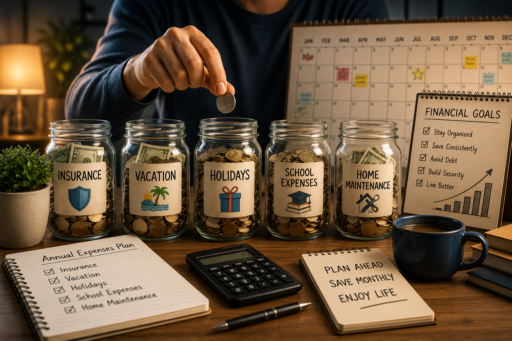
If you want to save for annual expenses without disrupting your monthly budget, the smartest approach is to plan ahead and set aside small amounts throughout the year. Annual expenses may seem unpredictable when they arrive; however, most of them are completely foreseeable.
Car insurance, school costs, holiday gifts, home maintenance, subscriptions, and vacations often create financial stress because they are large expenses that occur only once or twice a year. Fortunately, with the right system, you can prepare for these costs gradually and avoid relying on debt.
In this comprehensive guide, you will learn how to save for annual expenses the smart way using sinking funds, automation, and practical budgeting strategies that work in 2026 and beyond.
To strengthen your financial system, you may also want to read Best Sinking Funds to Start in 2026, How to Automate Your Savings Step by Step (2026 Guide), Best Budget Categories for Families in 2026, and How to Save Money on Utilities and Internet (2026 Guide).
Why Annual Expenses Cause Financial Stress
Annual expenses are not true emergencies. Instead, they are predictable costs that become stressful only when they are ignored.
According to the Consumer Financial Protection Bureau, planning for known future expenses is one of the most effective ways to reduce financial stress and avoid debt.
What Are Annual Expenses?
- Car insurance premiums
- Vehicle registration
- School expenses
- Holiday gifts
- Vacation costs
- Home repairs
- Medical deductibles
- Professional memberships
- Software renewals
- Tax preparation fees
Why Sinking Funds Are the Smartest Solution
Sinking funds allow you to divide large annual expenses into manageable monthly contributions.
Step 1: List Your Annual Expenses
Write down every expense you expect during the year.
Step 2: Estimate the Total Cost
Use previous bills or realistic projections to determine target amounts.
Step 3: Divide by 12
Convert annual costs into simple monthly savings goals.
Step 4: Create Separate Savings Categories
Track each annual expense individually.
Step 5: Automate Your Contributions
Automatic transfers make saving consistent and effortless.
Step 6: Review and Adjust Regularly
Update your estimates as costs change.
Sample Annual Expense Calculation
| Expense | Annual Cost | Monthly Savings |
|---|---|---|
| Car Insurance | $1,200 | $100 |
| Holiday Gifts | $600 | $50 |
| Vacation | $2,400 | $200 |
| Home Maintenance | $1,200 | $100 |
How Annual Expense Funds Reduce Stress
Saving gradually throughout the year eliminates the shock of large one-time costs.
How Families Benefit from Annual Planning
Families gain greater predictability and stronger cash flow control.
How to Prioritize Which Funds to Start First
Begin with the expenses most likely to create financial disruption.
How to Save for Annual Expenses on a Tight Budget
If your budget is limited, you can still save for annual expenses by starting with small monthly contributions. Even modest amounts create meaningful progress over time.
How to Save for Annual Expenses with Irregular Income
When your income fluctuates, estimate contributions conservatively and add extra amounts during stronger months.
How to Handle Unexpected Cost Increases
Inflation and changing prices may require periodic adjustments to your sinking fund targets.
Common Mistakes to Avoid
- Treating predictable expenses as emergencies
- Saving inconsistently
- Combining all funds without tracking categories
- Ignoring inflation
- Using the money for unrelated purchases
How Technology Makes Saving Easier
Budgeting apps, automatic transfers, and spreadsheets simplify annual expense planning.
What to Do with Unused Money
Carry remaining balances forward, increase next year’s goals, or redirect excess funds toward other priorities.
Examples of Additional Annual Expenses
- Medical expenses
- Pet care
- Professional certifications
- Birthday celebrations
- Tax payments
Protecting Your Financial Information
As you manage multiple accounts and savings categories, keep your financial data secure.
For additional protection, read:
- Protect Your Online Payments From Fraud (2026 Guide)
- Manage Passwords Securely Without Forgetting Them (2026)
- Secure Your Files on Cloud Storage (Google Drive & More) 2026
30-Day Annual Expense Savings Challenge
- List all annual expenses.
- Estimate costs.
- Divide totals by 12.
- Create sinking funds.
- Automate monthly transfers.
- Track balances.
- Review annually.
Frequently Asked Questions
How can I save for annual expenses?
Use sinking funds and save small amounts every month for predictable yearly costs.
What are the most important annual expenses to plan for?
Insurance, holidays, vacations, school costs, and home maintenance are common priorities.
Should I keep each fund separate?
Separate tracking improves organization, even if the money is stored in one account.
What if I cannot save much?
Start with small contributions and increase them gradually over time.
What happens if costs increase?
Review your targets and adjust your monthly contributions as needed.
Final Thoughts
Learning how to save for annual expenses the smart way can transform your budget and eliminate many predictable financial surprises.
By identifying recurring yearly costs, creating sinking funds, and automating your savings, you build a practical system that protects your cash flow and reduces stress.
Remember that annual expenses are not emergencies. They are opportunities to plan ahead and stay financially prepared.
Start with one or two important categories today, and continue expanding your system over time.
In the end, this simple strategy can help you enjoy greater financial stability and confidence throughout 2026 and beyond.