
Investing is one of the most effective ways to build wealth over time, but many investors focus only on choosing investments without fully understanding how returns work. Learning how to Understand Investment Returns is essential because investment returns ultimately determine whether you are making progress toward your financial goals.
Many beginners assume that a higher return automatically means a better investment. However, investment returns are more complex than they initially appear. Factors such as risk, inflation, time horizon, taxes, fees, and market conditions all influence the actual value of an investment’s performance.
Understanding investment returns helps investors evaluate opportunities more effectively, compare different investments, set realistic expectations, and make better long-term decisions. Whether you invest in stocks, bonds, ETFs, mutual funds, real estate, or other assets, knowing how returns are generated can significantly improve your financial knowledge.
In this guide, you’ll learn how to understand investment returns, the different types of returns, how to measure performance, and how to evaluate investment results more accurately.
What Are Investment Returns?
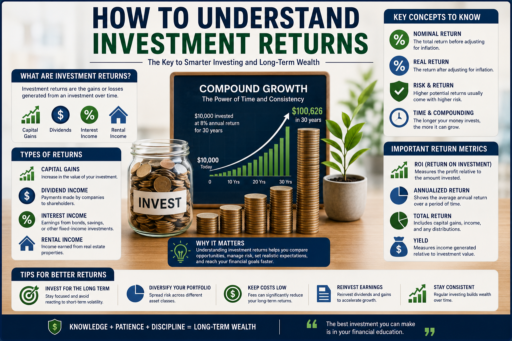
Investment returns refer to the gain or loss generated by an investment over a specific period of time.
Returns represent the reward investors receive for putting their money at risk.
Investment returns can come from:
- Capital appreciation.
- Dividend payments.
- Interest income.
- Rental income.
- Profit distributions.
If an investment increases in value or generates income, it produces a positive return. If it loses value, it generates a negative return.
For example:
- You invest $1,000.
- The investment grows to $1,100.
- Your gain is $100.
In this scenario, your investment return is 10%.
Why Understanding Investment Returns Matters
Many investors focus on headlines, stock prices, or market predictions without understanding the actual returns generated by their investments.
Learning to Understand Investment Returns helps you:
- Compare investment opportunities.
- Set realistic expectations.
- Measure financial progress.
- Evaluate portfolio performance.
- Manage risk more effectively.
- Make informed investment decisions.
Without understanding returns, investors may overestimate performance, underestimate risk, or make poor financial choices.
Types of Investment Returns
Investment returns can come from several different sources.
Understanding these sources helps investors evaluate opportunities more accurately.
1. Capital Gains
Capital gains occur when an investment increases in value.
For example:
- You purchase a stock for $50 per share.
- The stock increases to $70 per share.
- Your capital gain is $20 per share.
Capital gains are one of the most common forms of investment returns.
2. Dividend Income
Many companies distribute a portion of their profits to shareholders through dividends.
Dividend income provides investors with regular cash payments while still allowing them to participate in potential price appreciation.
Dividend-paying investments are often popular among long-term investors seeking passive income.
3. Interest Income
Bonds, savings products, and fixed-income investments often generate returns through interest payments.
Interest income is generally more predictable than stock market returns but may offer lower growth potential.
4. Rental Income
Real estate investments often generate returns through rental payments received from tenants.
Rental income can provide steady cash flow while properties potentially appreciate in value.
5. Business Income
Investments in private businesses may generate returns through profits, distributions, or increases in business value.
Business investments often carry unique risks and opportunities compared to publicly traded investments.
Understanding Percentage Returns
Investment performance is usually expressed as a percentage.
This allows investors to compare investments of different sizes.
The basic formula for calculating investment returns is:
Return = (Profit ÷ Initial Investment) × 100
Example:
- Initial investment: $5,000
- Ending value: $5,500
- Profit: $500
Return = ($500 ÷ $5,000) × 100 = 10%
Percentage returns make it easier to evaluate investment performance regardless of account size.
Annual Returns vs Total Returns
To properly Understand Investment Returns, investors should understand the difference between annual returns and total returns.
Total Return
Total return measures the overall gain or loss during the entire holding period.
Example:
- Investment grows from $10,000 to $15,000.
- Total gain = $5,000.
- Total return = 50%.
Annual Return
Annual return measures average yearly performance.
This metric allows investors to compare investments held for different periods of time.
Annual returns often provide a more accurate picture of long-term performance.
Nominal Returns vs Real Returns
Not all investment gains provide the same purchasing power.
Understanding the difference between nominal and real returns is essential.
Nominal Return
The nominal return is the raw investment return before adjusting for inflation.
For example:
- Investment return = 8%
- Inflation = 0%
- Nominal return = 8%
Real Return
The real return adjusts for inflation.
For example:
- Investment return = 8%
- Inflation = 3%
- Real return ≈ 5%
Real returns provide a more accurate measurement of wealth growth.
The Impact of Inflation on Investment Returns
Inflation gradually reduces purchasing power over time.
Even investments that generate positive returns may fail to increase real wealth if returns do not exceed inflation.
This is one reason why investors often seek growth-oriented investments for long-term goals.
Understanding inflation helps investors evaluate returns more realistically and avoid false assumptions about financial progress.
Risk and Return Relationship
One of the most important concepts investors must understand is the relationship between risk and return.
Generally speaking:
- Higher potential returns usually involve higher risk.
- Lower-risk investments often generate lower returns.
- There are no guaranteed high-return investments without risk.
Learning to Understand Investment Returns also means understanding the risks required to achieve those returns.
Different investors have different risk tolerances, which influences their investment choices.
How Compound Growth Affects Investment Returns
Compound growth is one of the most powerful concepts in investing. It occurs when investment earnings begin generating additional earnings over time.
Instead of earning returns only on your original investment, you earn returns on both your initial investment and previous gains.
For example:
- Initial investment: $10,000
- Annual return: 8%
- Investment period: 20 years
Without adding additional money, compound growth can significantly increase the value of an investment over long periods.
This is why many investors prioritize starting early rather than attempting to perfectly time the market.
Related Article: How to Calculate Investment Growth
How Time Influences Investment Returns
Time is one of the most important factors affecting investment performance.
Short-term returns can be highly unpredictable. Markets may experience periods of volatility, economic uncertainty, and sudden declines.
However, over longer periods, investments often have more opportunities to recover from temporary setbacks and benefit from compound growth.
Investors who remain focused on long-term objectives generally place greater emphasis on decades rather than months.
Understanding the role of time helps investors avoid making emotional decisions based on short-term market movements.
Comparing Different Investment Returns
Not all investments generate returns in the same way.
When comparing opportunities, investors should consider:
- Total return.
- Annual return.
- Risk level.
- Volatility.
- Income generation.
- Liquidity.
- Investment time horizon.
For example, one investment may generate higher returns but expose investors to significantly greater risk. Another may produce lower returns while providing more stability.
Understanding these trade-offs helps investors make decisions that align with their goals.
Common Return Metrics Investors Should Know
Several metrics can help investors evaluate performance more effectively. Investors who Understand Investment Returns often use these metrics to compare opportunities and measure long-term performance.
Return on Investment (ROI)
ROI measures how much profit an investment generates relative to the original amount invested.
It is one of the most widely used performance measurements.
Annualized Return
Annualized return shows the average yearly return generated by an investment.
This metric allows investors to compare investments held for different periods.
Total Return
Total return includes all gains generated by an investment, including appreciation, dividends, interest, and distributions.
Many investors consider total return one of the most comprehensive performance measurements.
Yield
Yield measures the income produced by an investment relative to its value.
Dividend stocks, bonds, and real estate investments often emphasize yield as an important return metric.
Understanding Positive and Negative Returns
Investment returns are not always positive.
Market declines can result in temporary or permanent losses depending on the circumstances.
For example:
- A stock purchased for $100 may decline to $80.
- The investment experiences a negative 20% return.
Understanding Investment Returns includes recognizing that losses are a normal part of investing.
Successful investors typically focus on long-term performance rather than reacting emotionally to short-term fluctuations.
How Fees Affect Investment Returns
Investment fees can significantly reduce long-term returns.
Common fees include:
- Management fees.
- Fund expense ratios.
- Advisory fees.
- Trading commissions.
While small fees may appear insignificant, they can compound over time and reduce overall wealth accumulation.
Many investors prefer low-cost investment options because keeping costs low allows more money to remain invested and continue growing.
How Taxes Influence Returns
Taxes can also affect actual investment performance.
Depending on local regulations, investors may pay taxes on:
- Capital gains.
- Dividends.
- Interest income.
- Investment distributions.
Understanding after-tax returns provides a more accurate picture of actual investment performance.
When evaluating investments, consider both gross returns and potential tax implications.
Mistakes Investors Make When Evaluating Returns
Focusing Only on High Returns
Higher returns often involve higher risk. Investors should evaluate both return potential and risk exposure.
Ignoring Inflation
Failing to account for inflation can create unrealistic expectations about wealth growth.
Comparing Different Time Periods
Comparing a one-year return to a ten-year return may produce misleading conclusions.
Overreacting to Short-Term Performance
Temporary market declines do not necessarily indicate investment failure.
Ignoring Fees and Taxes
Returns should always be evaluated after considering costs and taxes.
How to Track Investment Performance
Tracking performance helps investors measure progress toward financial goals.
Useful tracking methods include:
- Portfolio tracking software.
- Brokerage account reports.
- Investment spreadsheets.
- Annual performance reviews.
Regular reviews can help identify strengths, weaknesses, and opportunities for improvement.
However, excessive monitoring may encourage emotional decision-making. Many long-term investors review portfolios periodically rather than daily.
Developing Realistic Return Expectations
One of the most valuable skills investors can develop is setting realistic expectations.
Many advertisements, social media posts, and online discussions emphasize extraordinary returns. While exceptional gains occasionally occur, they are not typical.
Investors who Understand Investment Returns recognize that long-term wealth is often built through consistent growth, disciplined investing, diversification, and patience.
Reasonable expectations help investors remain committed during periods of market volatility and avoid unnecessary risks.
Related Article: Best Long-Term Investing Habits
Additional Resources for Learning
Financial education can improve investment decision-making and help investors evaluate opportunities more effectively.
For additional information about investment return basics, Investor.gov provides educational resources covering investment principles, risk management, diversification, and long-term investing concepts.
Related Article: How to Create a Personal Investment Strategy
Related Article: Best Financial Goals for Long-Term Wealth
Related Article: How to Balance Saving and Investing
Final Thoughts
Learning how to Understand Investment Returns is essential for becoming a more informed and confident investor. Returns help measure investment performance, evaluate opportunities, and determine whether you are making progress toward your financial goals.
By understanding different types of returns, the impact of inflation, the relationship between risk and reward, the benefits of compound growth, and the influence of fees and taxes, investors can make better financial decisions and develop more realistic expectations.
Successful investing is not simply about chasing the highest returns. It is about understanding how returns are generated, managing risk appropriately, staying disciplined, and maintaining a long-term perspective. With knowledge, patience, and consistency, investment returns can become a powerful tool for building long-term wealth.