
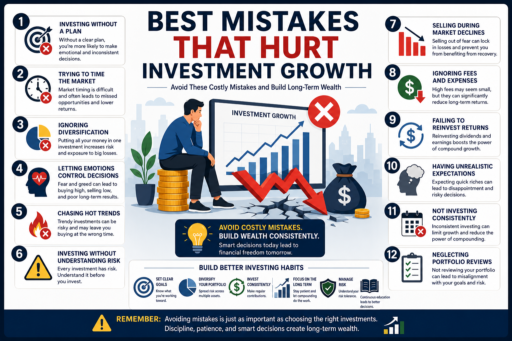
Investing is one of the most effective ways to build wealth over time, yet many investors fail to achieve their financial goals because of avoidable mistakes. Many of these Mistakes That Hurt Investment Growth can be prevented with proper planning, discipline, and financial education. While market fluctuations and economic uncertainty are normal parts of investing, poor decisions often have a much greater impact on long-term results than temporary market conditions.
Understanding the most common Mistakes That Hurt Investment Growth can help investors avoid costly errors, make better financial decisions, and improve their chances of long-term success. Many investing mistakes stem from emotional reactions, lack of planning, unrealistic expectations, or insufficient financial knowledge.
The good news is that most investing mistakes can be avoided. By recognizing common pitfalls and developing disciplined investing habits, investors can protect their portfolios and create stronger opportunities for long-term wealth accumulation.
In this guide, you’ll learn about the most common mistakes that hurt investment growth, why they occur, and how to avoid them.
Why Avoiding Investment Mistakes Matters
Successful investing is not always about finding the perfect stock or achieving extraordinary returns. Often, success comes from avoiding major mistakes that can significantly reduce long-term growth.
Avoiding costly errors helps investors:
- Protect capital.
- Reduce unnecessary risk.
- Stay focused on long-term goals.
- Improve portfolio performance.
- Build wealth more consistently.
- Reduce emotional decision-making.
Even small mistakes repeated over many years can have a substantial impact on investment results.
Mistake #1: Investing Without a Plan
One of the biggest Mistakes That Hurt Investment Growth is investing without a clear strategy.
Many beginners purchase investments based on recommendations, social media trends, or recent market performance without defining clear objectives.
A strong investment plan should include:
- Financial goals.
- Risk tolerance.
- Time horizon.
- Asset allocation.
- Investment selection criteria.
Without a plan, investors often make inconsistent decisions and struggle to remain disciplined during market volatility.
Related Article: How to Create a Personal Investment Strategy
Mistake #2: Trying to Time the Market
Many investors believe they can consistently predict market highs and lows.
Unfortunately, market timing is extremely difficult, even for experienced professionals.
Investors who constantly wait for the perfect opportunity often:
- Miss market gains.
- Delay investing.
- Increase emotional decision-making.
- Reduce long-term returns.
Consistent investing often produces better long-term results than attempting to predict short-term market movements.
Mistake #3: Ignoring Diversification
Diversification helps reduce risk by spreading investments across multiple assets, sectors, and investment types.
Investors who place all their money into a single stock, industry, or asset class increase portfolio risk unnecessarily.
Examples of diversification include:
- Different industries.
- Domestic and international investments.
- Stocks and bonds.
- Multiple ETFs and index funds.
Diversification cannot eliminate risk completely, but it can help reduce the impact of poor performance in any single investment.
Related Article: Best Ways to Diversify Your Investments
Mistake #4: Letting Emotions Control Decisions
Fear and greed are two of the most powerful forces in investing.
Many investors buy when prices are rising rapidly and sell when markets decline sharply.
Emotional investing often leads to:
- Buying high.
- Selling low.
- Poor timing.
- Inconsistent strategies.
- Reduced returns.
Successful investors rely on plans and discipline rather than emotions.
Mistake #5: Chasing Hot Trends
Trending investments can generate excitement, but chasing popular opportunities without proper research is one of the most common Mistakes That Hurt Investment Growth.
Investors often become interested in an asset after significant price increases have already occurred.
Examples may include:
- Popular stocks.
- Market bubbles.
- Speculative investments.
- Social media investment trends.
Investment decisions should be based on research and long-term objectives rather than hype.
Mistake #6: Investing Without Understanding Risk
Every investment involves some level of risk.
Investors who fail to understand risk may take positions that exceed their comfort level or financial capacity.
Important risk factors include:
- Market risk.
- Economic risk.
- Interest rate risk.
- Business risk.
- Liquidity risk.
Understanding risk helps investors choose investments that align with their goals and tolerance for volatility.
Mistake #7: Selling During Market Declines
Market downturns are a normal part of investing.
However, many investors panic and sell during periods of uncertainty.
Selling during declines can:
- Lock in losses.
- Reduce future growth opportunities.
- Disrupt long-term plans.
- Increase emotional stress.
Historically, markets have experienced periods of recovery following major declines. Long-term investors often benefit from maintaining discipline during difficult periods rather than making emotional decisions that become Mistakes That Hurt Investment Growth.
Mistake #8: Ignoring Fees and Expenses
Investment fees may seem small initially, but they can significantly reduce returns over time.
Common costs include:
- Management fees.
- Expense ratios.
- Trading commissions.
- Advisory fees.
Keeping costs low allows more of your investment returns to remain invested and continue compounding.
Mistake #9: Failing to Reinvest Returns
Many investors underestimate the power of reinvesting dividends, interest income, and other investment earnings.
Reinvestment allows returns to generate additional returns through compound growth.
Over long periods, reinvesting earnings can dramatically increase portfolio value.
Investors seeking long-term growth often benefit from automatic reinvestment programs when available.
Mistake #10: Having Unrealistic Expectations
Many investors enter the market expecting rapid wealth creation and extraordinary returns.
Unfortunately, unrealistic expectations often lead to disappointment and poor decision-making.
Investing is generally most effective when viewed as a long-term process rather than a quick path to wealth.
Investors who expect consistent double-digit returns every year may become frustrated during normal market fluctuations.
Successful investing typically involves patience, discipline, and realistic expectations.
Mistake #11: Not Investing Consistently
Consistency is one of the most important factors in long-term investing success.
Many investors contribute money only when markets appear favorable and stop investing during periods of uncertainty.
This inconsistent approach can reduce long-term growth opportunities.
Regular investing provides several advantages:
- Builds discipline.
- Reduces emotional decision-making.
- Supports long-term growth.
- Takes advantage of market fluctuations.
Investors who avoid the Mistakes That Hurt Investment Growth often prioritize consistency over market predictions.
Related Article: Best Long-Term Investing Habits
Mistake #12: Neglecting Portfolio Reviews
While excessive monitoring can be harmful, completely ignoring your investments can also create problems.
Periodic portfolio reviews help ensure investments remain aligned with:
- Financial goals.
- Risk tolerance.
- Time horizon.
- Asset allocation targets.
Reviewing your portfolio periodically allows you to identify opportunities for improvement and make necessary adjustments.
Many investors benefit from reviewing portfolios quarterly, semi-annually, or annually.
How to Build Better Investing Habits
Avoiding mistakes is only part of successful investing. Developing positive habits can significantly improve long-term results.
Examples include:
- Investing consistently.
- Following a written investment plan.
- Maintaining diversification.
- Reinvesting returns.
- Controlling emotions.
- Continuing financial education.
- Reviewing goals regularly.
Strong habits often have a greater impact on investment success than finding the next high-performing investment.
Signs Your Investment Strategy Is Improving
Investors who successfully avoid the most common Mistakes That Hurt Investment Growth often notice positive improvements over time.
Signs of progress may include:
- Greater confidence in investment decisions.
- More consistent contributions.
- Reduced emotional reactions.
- Improved diversification.
- Better understanding of risk.
- Steady portfolio growth.
These indicators suggest that your investing approach is becoming more disciplined and effective.
The Importance of Long-Term Thinking
Many investing mistakes occur because investors focus too heavily on short-term market movements.
Daily price changes, financial headlines, and market predictions can create unnecessary distractions.
Long-term investors typically focus on:
- Financial goals.
- Consistent contributions.
- Portfolio diversification.
- Risk management.
- Compound growth.
Maintaining a long-term perspective can help reduce emotional decision-making and improve investment outcomes.
Learning From Investment Mistakes
Even experienced investors occasionally make mistakes.
The key difference is that successful investors learn from those mistakes and use them as opportunities for improvement.
Instead of becoming discouraged, consider:
- Analyzing what went wrong.
- Identifying lessons learned.
- Improving future decision-making.
- Strengthening investment discipline.
Continuous improvement is often a major contributor to long-term investing success.
Additional Resources for Investors
Education is one of the most valuable tools available to investors.
The more you understand diversification, risk management, portfolio construction, and long-term investing principles, the easier it becomes to avoid costly mistakes.
For more information about investment risk and diversification, Investor.gov provides educational resources that help investors understand risk management and portfolio diversification strategies.
Related Article: How to Understand Investment Returns
Related Article: Best Ways to Increase Financial Security
Final Thoughts
Understanding the most common Mistakes That Hurt Investment Growth can help investors make smarter decisions and improve long-term financial outcomes. While no investment strategy can eliminate risk entirely, avoiding major mistakes can significantly increase the likelihood of achieving financial goals.
Investing without a plan, trying to time the market, ignoring diversification, letting emotions drive decisions, and failing to invest consistently are among the most common obstacles to long-term success.
By focusing on education, discipline, diversification, consistency, and long-term thinking, investors can create stronger portfolios and build wealth more effectively over time.
Remember that successful investing is often less about finding perfect investments and more about avoiding the mistakes that prevent long-term growth. Small improvements in decision-making today can produce significant financial benefits in the future.