
If you want to build a money routine that sticks, you are making one of the smartest decisions for your financial future. In fact, successful money management is rarely about one big breakthrough. Instead, it is built through small habits that are repeated consistently over time.
Many people create budgets, savings goals, and debt payoff plans. However, they often struggle to follow through for more than a few weeks. As a result, financial progress feels inconsistent and frustrating. Fortunately, the missing piece is usually a practical routine that turns good intentions into automatic habits.
A money routine is a set of regular financial actions you perform daily, weekly, and monthly. For example, you may review transactions, update your budget, automate savings, and monitor progress toward your goals. Over time, these actions become second nature. Consequently, managing money feels easier, more organized, and far less stressful.
In this comprehensive guide, you will learn exactly how to build a money routine that sticks. In addition, you will discover how to create habits you can maintain and design a financial system that works in 2026 and beyond.
To strengthen your overall financial system, you may also want to read Best Monthly Budget Template for Beginners (2026), Zero-Based Budgeting for Beginners (2026 Guide), How to Automate Your Savings Step by Step (2026 Guide), and Best Sinking Funds to Start in 2026.
Why Financial Success Depends on Routine
Money management becomes much easier when key actions happen regularly. Rather than making random financial decisions, you follow a consistent process.
According to the Consumer Financial Protection Bureau, building structured budgeting habits is one of the most effective ways to improve financial stability and reduce money stress.
What Is a Money Routine?
A money routine is a repeating schedule of financial tasks such as reviewing transactions, updating your budget, paying bills, automating savings, and checking progress toward goals.
Once these actions become habits, managing money feels simpler and more predictable.
Benefits of a Strong Money Routine
- Reduces financial stress
- Improves budgeting accuracy
- Increases savings consistency
- Prevents missed bills
- Accelerates debt payoff
- Builds confidence
Step 1: Define Your Financial Goals
Clear goals provide direction and motivation.
- Build an emergency fund
- Pay off debt
- Save for travel
- Invest for retirement
- Stop living paycheck to paycheck
Step 2: Choose Your Core Financial Tools
Select tools you will use consistently.
- Budget spreadsheet
- Banking app
- Calendar reminders
- Savings automation
- Password manager
Step 3: Create a Daily Money Habit
Spend five minutes reviewing transactions and account balances.
Step 4: Establish a Weekly Money Date
Set aside 20 to 30 minutes each week to update your budget and review progress.
Step 5: Conduct a Monthly Financial Review
Analyze spending patterns, savings growth, and debt reduction at the end of each month.
Step 6: Automate Repetitive Tasks
Automatic transfers and bill payments reduce effort and improve consistency.
Step 7: Build Sinking Funds
Prepare for irregular expenses like insurance, travel, and holidays.
Step 8: Track Key Metrics
Monitor savings rate, debt balances, and net worth over time.
Step 9: Simplify Your System
The best money routine is one you can maintain consistently.
Step 10: Stay Flexible
Your routine should evolve as your income, expenses, and goals change.
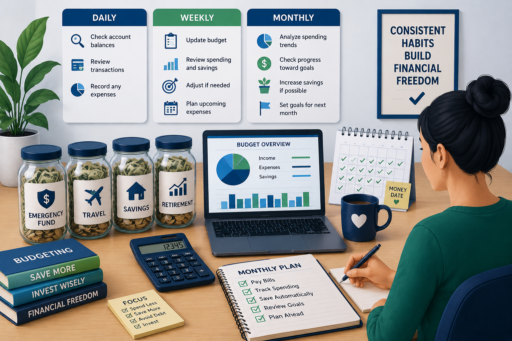
Sample Daily Money Routine
- Check account balances
- Review recent transactions
- Record unusual expenses
Sample Weekly Money Routine
- Update your budget
- Review savings progress
- Adjust categories if needed
- Plan upcoming expenses
Sample Monthly Money Routine
- Analyze spending trends
- Increase savings if possible
- Review financial goals
- Set priorities for the next month
How a Money Routine Helps You Save More
Consistent review and automation make saving a natural part of your financial life.
How a Money Routine Helps You Pay Off Debt
Regular tracking keeps debt reduction visible and motivating.
How a Money Routine Supports Zero-Based Budgeting
A routine ensures every dollar is assigned a purpose and monitored regularly.
How a Money Routine Prevents Financial Stress
Structured habits reduce uncertainty and improve confidence.
How to Build a Money Routine That Sticks with Irregular Income
If your income changes from month to month, you can still build a money routine that sticks by focusing on consistency rather than perfection. Review your income weekly, update your budget frequently, and automate a conservative amount toward savings.
How Families Can Create a Shared Money Routine
Families benefit when both partners participate in regular money meetings. Reviewing goals together improves communication and reduces financial misunderstandings.
How Freelancers Can Maintain Financial Discipline
Freelancers should include tax savings, business expenses, and income forecasting in their weekly and monthly money routines.
How Students Can Start Early
Students can build powerful habits by tracking spending, automating small savings transfers, and reviewing finances weekly.
Common Mistakes That Break Money Routines
- Making the system too complicated
- Setting unrealistic goals
- Skipping reviews for several weeks
- Trying to be perfect
- Ignoring irregular expenses
How to Recover After Falling Behind
Missing a week or even a month does not ruin your progress. Simply restart your routine and continue moving forward.
Psychological Benefits of Financial Routines
- Less anxiety
- More confidence
- Greater clarity
- Improved discipline
- Better decision-making
Technology and Financial Security
Modern apps, automatic transfers, and secure cloud tools make it easier to maintain a reliable money routine.
For additional protection, read:
- Protect Your Online Payments From Fraud (2026 Guide)
- Manage Passwords Securely Without Forgetting Them (2026)
- Secure Your Files on Cloud Storage (Google Drive & More) 2026
30-Day Money Routine Challenge
- Define one financial goal.
- Create a simple budget.
- Schedule a weekly money date.
- Automate savings.
- Track spending daily.
- Review progress each week.
- Conduct a monthly review.
Frequently Asked Questions
What is a money routine?
A money routine is a repeating schedule of financial tasks that helps you manage money consistently.
How long does it take to build a money routine?
Many people establish strong habits within 30 to 90 days.
How often should I review my finances?
Daily check-ins, weekly reviews, and monthly assessments work very well.
Can I build a money routine with low income?
Absolutely. The routine matters more than the starting amount.
What is the most important habit?
A weekly money date is often the most effective habit for maintaining financial control.
Final Thoughts
Learning how to build a money routine that sticks can transform the way you manage your finances. Rather than relying on motivation alone, you create systems and habits that produce steady progress over time.
By combining daily awareness, weekly reviews, monthly evaluations, automated savings, and clear financial goals, you build a framework that supports long-term success.
Whether you are paying off debt, building an emergency fund, or working toward financial freedom, a strong money routine provides the structure needed to stay consistent.
Remember, financial success is rarely the result of one perfect decision. It is the product of small, repeated actions that become lifelong habits.
Start today with a simple five-minute money check-in. Over time, this routine can create extraordinary results and lasting financial stability in 2026 and beyond.