
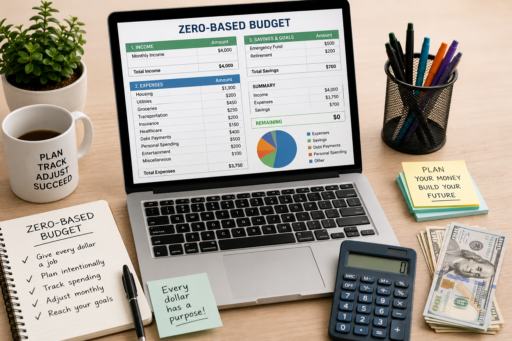
If you want to understand zero-based budgeting explained for beginners, you are learning one of the most effective money management methods ever created. This budgeting approach gives every dollar a specific job, helping you take full control of your finances and eliminate wasteful spending.
Many people earn a steady income but still feel overwhelmed by bills, debt, and financial uncertainty. As a result, they struggle to save money and make progress toward important goals. Fortunately, zero-based budgeting provides a simple and highly structured solution.
With this method, your income minus your planned expenses equals zero. That does not mean you spend everything. Instead, it means every dollar is assigned to a category such as housing, groceries, savings, investing, or debt repayment.
In this complete guide, you will learn what zero-based budgeting is, how it works, how to build your own zero-based budget, and why it is one of the best budgeting systems for beginners in 2026.
To strengthen your financial foundation, you may also want to read Best Monthly Budget Template for Beginners (2026), How to Stop Living Paycheck to Paycheck in 2026, Simple Personal Finance System That Actually Works (2026), and Protect Your Online Payments From Fraud (2026 Guide).
What Is Zero-Based Budgeting?
Zero-based budgeting is a budgeting method where every dollar of income is assigned a purpose before the month begins.
The basic formula is:
Income − Expenses − Savings − Debt Payments = $0
When the remaining balance equals zero, every dollar has been allocated intentionally.
For anyone researching zero-based budgeting for beginners, this method offers a simple and highly effective way to organize income, expenses, savings, and debt with complete clarity.
Why Zero-Based Budgeting Works So Well
Zero-based budgeting forces you to plan every dollar instead of spending without direction. Consequently, you gain complete visibility into your financial situation.
- Prevents overspending
- Increases savings
- Accelerates debt payoff
- Reduces financial stress
- Creates clear priorities
- Builds long-term discipline
According to the Consumer Financial Protection Bureau, creating a detailed spending plan is one of the most effective ways to improve financial stability and reduce money stress.
Zero-Based Budgeting vs Traditional Budgeting
| Traditional Budgeting | Zero-Based Budgeting |
|---|---|
| Tracks spending loosely | Assigns every dollar a purpose |
| May leave money unallocated | Remaining balance equals zero |
| Easier to overspend | Promotes intentional spending |
| Less detailed | Highly structured |
Who Should Use Zero-Based Budgeting?
This method is especially effective for:
- Beginners
- Families
- Students
- Freelancers
- People with debt
- Anyone trying to save more money
How the Zero-Based Budget Formula Works
Suppose your monthly income is $4,000.
| Category | Amount |
|---|---|
| Housing | $1,300 |
| Utilities | $200 |
| Groceries | $450 |
| Transportation | $250 |
| Insurance | $200 |
| Debt Payments | $400 |
| Savings | $700 |
| Personal Spending | $500 |
Total allocated: $4,000
Remaining balance: $0
Step 1: Calculate Your Monthly Income
Add all reliable income sources, including salary, freelance work, side hustles, and passive income.
Step 2: List Essential Expenses
Start with housing, utilities, groceries, transportation, and insurance.
Step 3: Add Savings Goals
Include emergency fund contributions, retirement investing, and short-term savings goals.
Step 4: Include Debt Payments
Allocate money toward credit cards, loans, and any additional debt repayment.
Step 5: Assign Every Remaining Dollar
Any money left should be assigned to savings, investments, or other planned categories until the balance reaches zero.
Step 6: Track Spending Throughout the Month
Update your budget weekly and compare actual spending against your plan.
Step 7: Adjust as Needed
If one category exceeds expectations, reduce another category while keeping your total allocation equal to your income.
The Biggest Benefits of Zero-Based Budgeting
Complete Financial Awareness
You know exactly where every dollar goes.
Better Spending Decisions
Every purchase becomes intentional.
Faster Savings Growth
Savings are treated as a priority, not an afterthought.
Accelerated Debt Payoff
Extra money is assigned to debt reduction.
Reduced Financial Anxiety
Planning creates clarity and confidence.
Common Zero-Based Budget Categories
- Housing
- Utilities
- Groceries
- Transportation
- Insurance
- Healthcare
- Debt Payments
- Savings
- Investments
- Entertainment
- Dining Out
- Travel
- Gifts
- Miscellaneous
Zero-Based Budgeting and Emergency Funds
This method works exceptionally well for building an emergency fund because savings are planned before spending begins.
Zero-Based Budgeting and Debt Payoff
If you are trying to eliminate debt, zero-based budgeting can dramatically accelerate your progress by assigning every extra dollar to repayment.
How Zero-Based Budgeting Helps You Stop Living Paycheck to Paycheck
By giving every dollar a purpose, you reduce wasteful spending and gradually build financial stability.
Best Tools for Zero-Based Budgeting
- Google Sheets
- Microsoft Excel
- YNAB
- EveryDollar
- Monarch Money
How to Use Zero-Based Budgeting with Irregular Income
If your income changes from month to month, zero-based budgeting is still highly effective. The best approach is to build your budget using your lowest expected monthly income. Then, when you earn more than expected, assign every extra dollar to savings, taxes, investing, or debt repayment.
Zero-Based Budgeting for Freelancers
Freelancers and self-employed professionals often experience income fluctuations. Therefore, zero-based budgeting can provide stability by ensuring every dollar is planned in advance. In addition, creating categories for taxes and business expenses helps prevent unpleasant surprises.
Zero-Based Budgeting for Families
Families can benefit tremendously from this budgeting method. Shared financial planning improves communication, reduces stress, and helps both partners work toward common goals such as paying off debt, saving for education, and building long-term wealth.
Zero-Based Budgeting for Students
Students can use zero-based budgeting to manage tuition, books, transportation, and part-time income. Learning this system early can create strong financial habits that last a lifetime.
How to Handle Unexpected Expenses
Unexpected expenses are inevitable. Fortunately, zero-based budgeting makes it easier to prepare by including sinking funds and emergency savings as part of your monthly plan.
Sinking Funds Explained
Sinking funds are small amounts set aside each month for known future expenses.
- Car maintenance
- Insurance premiums
- Holiday gifts
- Travel
- Home repairs
- Medical expenses
Common Mistakes Beginners Make
- Forgetting irregular expenses
- Setting unrealistic spending limits
- Failing to track actual spending
- Not adjusting the budget monthly
- Giving up after one mistake
Zero-Based Budgeting vs the 50/30/20 Rule
| 50/30/20 Rule | Zero-Based Budgeting |
|---|---|
| Simple percentage-based method | Detailed dollar-by-dollar planning |
| Less precise | Highly structured |
| Good for beginners | Excellent for maximum control |
Psychological Benefits of Zero-Based Budgeting
Budgeting is not just about numbers. It also changes the way you think about money.
- Reduces anxiety
- Increases confidence
- Improves decision-making
- Creates a sense of control
- Builds financial discipline
Digital Security and Financial Organization
Modern budgeting often involves online banking, cloud storage, and password managers. Protecting your financial information is therefore essential.
For additional security, read:
- Protect Your Online Payments From Fraud (2026 Guide)
- Manage Passwords Securely Without Forgetting Them (2026)
- Secure Your Files on Cloud Storage (Google Drive & More) 2026
Recommended Apps for Zero-Based Budgeting
- YNAB (You Need A Budget)
- EveryDollar
- Google Sheets
- Microsoft Excel
- Monarch Money
30-Day Zero-Based Budget Challenge
- Calculate your income.
- List all expenses.
- Assign every dollar a purpose.
- Track spending daily.
- Review weekly.
- Adjust categories as needed.
- Save consistently.
- Evaluate your results.
Frequently Asked Questions
What is zero-based budgeting?
It is a budgeting method where every dollar of income is assigned a specific purpose until the remaining balance equals zero.
Is zero-based budgeting good for beginners?
Yes. It is one of the most effective systems for gaining complete control over your finances.
Does zero-based budgeting mean spending all your money?
No. Savings and investing are assigned categories, so every dollar still has a planned purpose.
How often should I update my budget?
Weekly reviews are ideal for staying on track.
Can I use zero-based budgeting with irregular income?
Absolutely. Base your budget on your lowest expected income and assign extra earnings strategically.
Final Thoughts
Understanding zero-based budgeting explained for beginners can completely transform the way you manage money. By assigning every dollar a specific purpose, you gain clarity, reduce wasteful spending, and build stronger financial habits.
Whether you want to save more money, pay off debt, or stop living paycheck to paycheck, zero-based budgeting provides a practical and highly effective system.
Start with a simple spreadsheet, track your spending, and adjust your budget each month. Over time, this disciplined approach can lead to remarkable financial progress.
Remember, budgeting is not about restriction. Instead, it is about intentionality, freedom, and making every dollar work toward your goals.
When every dollar has a purpose, your money begins to serve you instead of controlling you. That is the true power of zero-based budgeting in 2026 and beyond.