
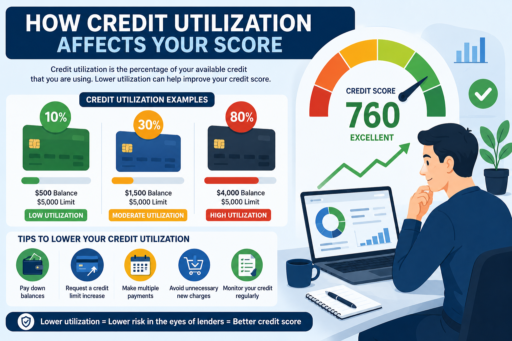
Imagine this situation: you’ve paid every credit card bill on time for months, avoided late payments, and worked hard to improve your financial habits. Then you check your credit score expecting a noticeable increase, only to find that it barely moved. It can feel frustrating because you’re doing everything right—or at least it seems that way. In many cases, the missing piece is understanding how Credit Utilization Affects Your Score and why high balances can hold back credit improvement even when payments are always made on time.
What many people don’t realize is that payment history is only one part of the credit scoring equation. Another major factor often works quietly in the background: credit utilization. In fact, a person who never misses a payment can still struggle with a lower credit score if too much of their available credit is being used.
Understanding how Credit Utilization Affects Your Score is one of the most important steps toward building stronger credit. Whether you’re trying to qualify for a better credit card, improve loan approval chances, or simply strengthen your overall financial profile, learning how utilization works can make a significant difference.
In this guide, you’ll learn what credit utilization is, why it matters, how it is calculated, common mistakes people make, and practical ways to improve it.
What Is Credit Utilization?
Credit utilization refers to the percentage of your available revolving credit that you’re currently using.
In simple terms, it compares your credit card balances to your total credit limits.
For example, imagine you have:
- One credit card with a $5,000 limit.
- A current balance of $1,000.
Your utilization rate would be:
$1,000 ÷ $5,000 = 20%
This means you’re using 20% of your available credit.
Credit scoring systems often view lower utilization rates more favorably because they suggest responsible credit management.
Why Credit Utilization Matters
Many lenders use credit scores to evaluate risk. Their goal is to determine how likely someone is to manage debt responsibly.
When a borrower consistently uses a large percentage of available credit, lenders may interpret that as a sign of financial stress or increased borrowing dependence.
Even if payments are made on time, high utilization can sometimes signal elevated risk.
This is why understanding how Credit Utilization Affects Your Score is so important.
Many consumers focus exclusively on paying bills on time while completely ignoring utilization levels.
Both factors matter.
For more information about credit utilization and credit scores, the Consumer Financial Protection Bureau provides educational resources covering credit reports, credit scores, borrowing, and responsible credit management.
How Credit Utilization Is Calculated
The formula is straightforward:
Credit Utilization = Total Credit Card Balances ÷ Total Credit Limits × 100
Let’s look at a few examples.
Example 1
- Total credit limit: $10,000
- Total balance: $1,000
Utilization = 10%
Example 2
- Total credit limit: $10,000
- Total balance: $3,000
Utilization = 30%
Example 3
- Total credit limit: $10,000
- Total balance: $8,000
Utilization = 80%
As utilization increases, credit scores often face greater pressure.
A Real-World Example Most People Experience
Consider two individuals.
Sarah has a credit card with a $10,000 limit and carries a balance of $500.
Her utilization is only 5%.
Michael has the same credit limit but carries a balance of $8,000.
His utilization is 80%.
Neither person has missed a payment.
However, credit scoring systems generally view Sarah’s profile more favorably because she uses a much smaller portion of her available credit.
This example illustrates how Credit Utilization Affects Your Score even when payment histories are identical.
What Is Considered Good Credit Utilization?
While there is no universal number that guarantees a specific credit score, many financial professionals use these general guidelines:
- Below 10% — Excellent
- 10% to 30% — Generally good
- 30% to 50% — May begin affecting scores
- Above 50% — Often viewed negatively
- Above 75% — Can significantly impact scores
Lower utilization rates generally provide stronger signals of responsible credit management.
This doesn’t mean you must stop using your credit cards. Instead, it means managing balances strategically.
Why High Utilization Can Lower Scores
Imagine lending money to two people.
One person consistently uses only a small portion of available credit.
The other regularly keeps credit cards close to their limits.
Which person would appear financially stronger?
Most lenders would choose the first individual.
High utilization may suggest:
- Greater reliance on borrowing.
- Reduced financial flexibility.
- Potential difficulty handling unexpected expenses.
- Higher future repayment risk.
Because of these concerns, credit scoring systems often reward lower utilization levels.
The Difference Between 10%, 30%, and 80% Utilization
Many people assume a balance is either good or bad. In reality, utilization exists on a spectrum.
Someone using 10% of available credit typically presents a much different risk profile than someone using 80%.
For example:
- 10% utilization often supports stronger scores.
- 30% utilization may still be manageable.
- 80% utilization often creates downward pressure on scores.
Small changes in utilization can sometimes produce noticeable score improvements.
How Credit Card Limits Affect Utilization
Many people focus only on balances.
However, credit limits matter just as much.
Imagine you carry a $2,000 balance.
If your limit is $3,000, utilization is roughly 67%.
If your limit is $10,000, utilization is only 20%.
The balance remains identical, yet the utilization picture changes dramatically.
This is another example of how Credit Utilization Affects Your Score beyond simply looking at debt amounts.
Related Article: Best Credit Cards for Building Credit
How Multiple Credit Cards Influence Utilization
One area that often confuses consumers is how utilization works when multiple credit cards are involved.
Many people assume that only the overall utilization matters. While total utilization is important, individual card utilization can also play a role.
Consider this example:
- Card A: $5,000 limit, $4,500 balance
- Card B: $5,000 limit, $0 balance
Total utilization is 45%, which may not seem terrible at first glance.
However, Card A is using 90% of its available limit.
Some scoring models may view that differently than someone who spreads balances more evenly across accounts.
This is why it’s often beneficial to avoid maxing out individual cards, even if your overall utilization appears reasonable.
Common Credit Utilization Mistakes
Many people unintentionally hurt their credit scores because they misunderstand how utilization works.
Some of the most common mistakes include:
Using Most of a Credit Limit
A common misconception is that staying below the credit limit is enough.
Technically, yes—you are within the limit.
But a card carrying an 85% utilization rate may still negatively affect your score.
Only Making Minimum Payments
Paying the minimum prevents late payments, but balances may remain high for long periods.
High balances often lead to higher utilization.
Closing Old Credit Cards
Many consumers close unused cards believing it will improve their finances.
However, closing an account reduces available credit.
Less available credit can increase utilization instantly.
For example:
- Total limits before closing: $20,000
- Balances: $2,000
- Utilization: 10%
After closing a card with a $10,000 limit:
- Total limits: $10,000
- Balances: $2,000
- Utilization: 20%
Nothing changed except the available credit, yet utilization doubled.
Ignoring Statement Dates
Many people pay their cards in full every month but still report high utilization because balances are reported before payments are made.
This leads to another important concept.
Should You Pay Before the Statement Date?
Imagine your card has:
- $5,000 credit limit
- $2,500 current balance
If the statement closes today, a 50% utilization rate may be reported.
However, if you pay $2,000 before the statement closes, the reported balance may be only $500.
Now utilization becomes 10%.
Many people who actively manage their credit scores make payments before statement dates for this exact reason.
This strategy doesn’t eliminate debt, but it can help present a lower utilization rate to credit bureaus.
How to Lower Credit Utilization Quickly
If your utilization is currently high, don’t panic.
There are several practical ways to reduce it.
Pay Down Existing Balances
The most direct solution is reducing outstanding balances.
Every dollar paid toward revolving debt lowers utilization.
Make Multiple Payments Each Month
Instead of making one monthly payment, some consumers make weekly or biweekly payments.
This keeps reported balances lower throughout the month.
Request a Credit Limit Increase
If approved, a higher limit may reduce utilization without requiring balance reductions.
For example:
- Balance: $2,000
- Current limit: $5,000
- Utilization: 40%
After a limit increase to $10,000:
- Balance: $2,000
- Utilization: 20%
The balance didn’t change, but utilization improved significantly.
Avoid New Debt
Adding new purchases while trying to lower utilization often slows progress.
Focusing on balance reduction usually produces faster results.
Can Credit Utilization Change Every Month?
Absolutely.
This is one reason utilization is different from some other credit score factors.
Your payment history may take years to build, but utilization can change in a single billing cycle.
If balances rise dramatically one month, scores may be affected.
If balances fall the following month, scores may recover.
This flexibility makes utilization one of the fastest areas where consumers can influence their credit profile.
How Credit Utilization Affects Long-Term Credit Health
Think of utilization like blood pressure.
A temporary increase may not create a long-term problem.
However, consistently high levels can indicate ongoing financial strain.
People with strong credit profiles often maintain healthy utilization habits year after year.
They use credit cards regularly but avoid carrying balances that consume large portions of available limits.
This balance between usage and control is a key part of long-term credit success.
Related Article: Credit Score Improvement Strategies
Credit Utilization Myths
Myth #1: You Should Never Use Credit Cards
Some people believe avoiding credit cards entirely improves credit scores.
In reality, responsible usage often helps establish positive credit history.
Myth #2: Carrying a Small Balance Improves Scores
Many consumers believe carrying debt month after month helps build credit.
Generally, paying balances responsibly is more important than carrying unnecessary debt.
Myth #3: Utilization Doesn’t Matter If Payments Are On Time
This is one of the most expensive misconceptions.
Even perfect payment history may not fully offset extremely high utilization levels.
Best Habits for Maintaining Low Utilization
If you want stronger credit health over the long term, focus on habits rather than shortcuts.
- Monitor balances regularly.
- Pay more than the minimum when possible.
- Avoid maxing out cards.
- Review statements carefully.
- Track utilization percentages monthly.
- Maintain emergency savings to reduce dependence on credit.
Related Article: How to Avoid Credit Card Interest*
Related Article: Best Starter Credit Cards for Young Adults
Related Article: How to Read a Credit Card Statement
How Credit Utilization Is Reported to Credit Bureaus
One of the biggest misconceptions about credit utilization is that lenders constantly monitor your balance in real time. In reality, most credit card issuers report account information periodically, often around the statement closing date.
This means your credit report may reflect the balance reported on that date rather than the balance you carry throughout the month. For example, a consumer may pay off their credit card in full every month yet still appear to have high utilization if a large balance is reported before payment is made.
Understanding reporting cycles can help consumers manage utilization more effectively. Some individuals choose to make payments before statement closing dates to reduce reported balances and improve utilization percentages.
This reporting process is another example of how Credit Utilization Affects Your Score even when spending habits remain unchanged.
Credit Utilization During Financial Emergencies
Financial emergencies sometimes force people to rely on credit cards. Unexpected medical expenses, vehicle repairs, temporary unemployment, or urgent home repairs can cause balances to increase rapidly.
While using available credit during emergencies is often better than missing essential payments, consumers should understand the potential impact on their credit profiles.
High utilization caused by temporary emergencies does not necessarily create permanent damage. Many credit scores improve after balances are reduced and utilization returns to healthier levels.
The key is creating a repayment plan as quickly as possible and avoiding long-term dependence on revolving debt.
Credit Utilization vs Payment History
Many people wonder which factor matters more: payment history or utilization.
The answer is that both are extremely important, but they influence scores differently.
Payment history reflects whether you pay obligations on time. Credit utilization reflects how much of your available credit you currently use.
A borrower with perfect payment history but very high utilization may still experience lower scores. Likewise, someone with low utilization but frequent late payments may also struggle.
The strongest credit profiles typically combine consistent on-time payments with healthy utilization levels.
Monthly Action Plan for Lowering Credit Utilization
If your utilization is currently above 30%, consider a simple monthly improvement plan.
- Review all credit card balances.
- Identify the highest-utilization account.
- Pay more than the minimum whenever possible.
- Avoid unnecessary purchases.
- Monitor statement closing dates.
- Track utilization percentages monthly.
Small improvements repeated consistently often produce better long-term results than drastic short-term actions.
Many consumers discover that lowering utilization by only 10% to 20% can significantly improve their overall credit profile over time.
Final Thoughts
Understanding how Credit Utilization Affects Your Score can help you make smarter financial decisions and improve your overall credit health. While many people focus exclusively on payment history, utilization remains one of the most influential factors in most credit scoring systems.
The good news is that utilization is also one of the easiest factors to improve. By lowering balances, managing credit limits wisely, monitoring statement dates, and maintaining responsible spending habits, you can often see meaningful improvements in your credit profile.
Building excellent credit rarely comes from one big action. More often, it comes from small, consistent decisions repeated over time. Managing credit utilization effectively is one of those decisions that can pay off for years to come.