
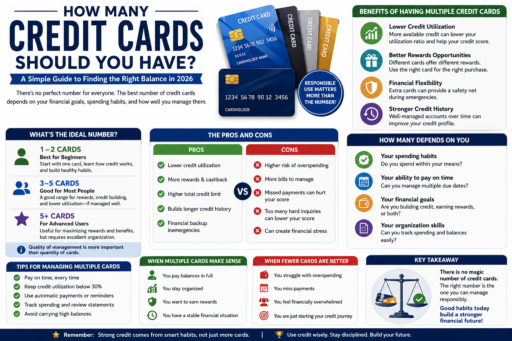
Many people wonder whether having multiple credit cards is good or bad for their financial health. Some people avoid extra cards completely, while others carry several cards for rewards, travel benefits, or higher credit limits.
Learning how many credit cards should you have can help you build credit responsibly, manage spending more effectively, and avoid unnecessary financial stress.
The truth is that there is no single perfect number for everyone. The ideal number depends on your financial habits, income, organization skills, and long-term goals.
In this beginner-friendly guide, you will learn:
- How many credit cards most people should have
- How multiple accounts affect your credit score
- The benefits of having several cards
- The risks of too many accounts
- How beginners should approach multiple cards
- How to manage several cards responsibly
- Common mistakes to avoid
What Does How Many Credit Cards Should You Have Mean?
Finding the right balance between building credit effectively and avoiding financial mismanagement is important when deciding how many credit cards you should have.
Having multiple cards may help:
- Increase available credit
- Improve credit utilization
- Earn rewards
- Build credit history
However, too many cards may also create:
- Overspending risks
- Missed payments
- Financial stress
- Management difficulties
Why How Many Credit Cards Should You Have Matters
The number of cards you carry can influence your financial habits and credit profile.
Managing cards responsibly may help:
- Improve your credit score
- Increase financial flexibility
- Reduce credit utilization
- Build stronger credit history
According to Experian, the ideal number of credit cards depends on your ability to manage them responsibly.
Is Having Multiple Credit Cards Bad?
No — multiple credit cards are not automatically bad.
What matters most is how responsibly you manage them.
People with excellent credit scores often have several credit accounts because they:
- Pay on time
- Keep balances low
- Stay organized
- Avoid unnecessary debt
Benefits of Having Multiple Credit Cards
1. Lower Credit Utilization
More available credit may reduce your utilization ratio.
Example:
- One card with $1,000 limit and $500 balance = 50% utilization
- Two cards with total $4,000 limit and same $500 balance = 12.5% utilization
Lower utilization may improve your credit score.
2. Better Rewards Opportunities
Different cards may offer:
- Cash back
- Travel rewards
- Dining rewards
- Gas rewards
Some people strategically use different cards for different spending categories.
3. Financial Backup During Emergencies
Multiple cards may provide temporary financial flexibility during emergencies.
4. Stronger Credit History
Older well-managed accounts may strengthen your credit profile over time.
Risks of Having Too Many Credit Cards
1. Overspending
More available credit may tempt some people into unnecessary debt.
2. Missed Payments
Managing multiple due dates can become confusing.
If you want to understand late payment risks, read our article on What Happens If You Miss a Credit Card Payment.
3. Harder Budgeting
Tracking multiple balances may become difficult without organization.
4. Too Many Hard Inquiries
Applying for several cards quickly may temporarily lower your score.
How Many Credit Cards Should Beginners Have?
Most beginners only need one credit card initially.
Managing one card responsibly helps build healthy habits before adding more accounts.
Beginners should focus on:
- Paying on time
- Tracking spending
- Keeping balances low
- Avoiding debt
After gaining experience, additional cards may become easier to manage.
How Many Credit Cards Do People Usually Have?
There is no perfect universal number.
Some people prefer:
- 1–2 cards for simplicity
- 3–5 cards for rewards optimization
- More accounts for advanced strategies
The correct number depends entirely on financial discipline and organization.
Should You Close Old Credit Cards?
Closing old accounts is not always the best decision.
Older cards may help:
- Increase account age
- Improve utilization
- Strengthen credit history
However, cards with high annual fees may sometimes be worth closing.
When Multiple Cards Make Sense
Having several cards may make sense if you:
- Pay balances in full
- Track spending carefully
- Never miss payments
- Use rewards strategically
- Stay within budget
Responsible habits matter more than the number itself.
When Fewer Cards Are Better
Fewer cards may be better if you:
- Struggle with overspending
- Forget due dates
- Feel financially overwhelmed
- Have difficulty budgeting
Simplicity often helps beginners avoid financial mistakes.
How to Manage Multiple Cards Responsibly
1. Use Automatic Payments
Automatic payments help prevent missed due dates.
2. Track Spending Weekly
Regular monitoring improves financial awareness.
3. Keep Utilization Low
Experts generally recommend staying below 30% utilization.
4. Avoid Carrying Large Balances
Paying balances fully helps avoid expensive interest charges.
Learn more in our article on How to Avoid Credit Card Interest.
Should You Apply for Multiple Cards Quickly?
Applying for many cards in a short time may:
- Increase hard inquiries
- Reduce approval chances
- Lower your score temporarily
Slow and responsible growth is usually the safer strategy.
Best Credit Card Strategy for Young Adults
Young adults and beginners usually benefit most from:
- Starting with one card
- Building positive payment history
- Keeping balances low
- Learning budgeting skills
After building confidence and organization skills, additional cards may become easier to manage.
If you are starting from scratch, read our article on Best Starter Credit Cards for Young Adults.
Common Mistakes With Multiple Credit Cards
1. Overspending for Rewards
Rewards are not worth expensive debt.
2. Missing Payments
Multiple accounts increase organizational complexity.
3. Applying Too Frequently
Too many applications may hurt approval odds.
4. Ignoring Statements
Monitoring accounts helps detect problems early.
5. Carrying High Balances
High balances may hurt utilization and increase stress.
Best Beginner Habits for Managing Credit Cards
- Pay on time every month
- Track spending carefully
- Keep balances low
- Use automatic payments
- Stay within your budget
These habits matter far more than the exact number of cards you own.
Final Thoughts on How Many Credit Cards Should You Have
Learning how many credit cards should you have can help you create a healthier balance between building credit and avoiding financial stress.
There is no perfect number for everyone.
Some people manage several cards successfully, while others prefer simplicity with only one or two accounts.
The most important factor is responsible financial behavior.
Focus on:
- Paying on time
- Keeping balances low
- Avoiding unnecessary debt
- Tracking spending carefully
- Staying financially organized
Most importantly, remember that strong credit is built through consistent habits — not simply by owning more credit cards.