
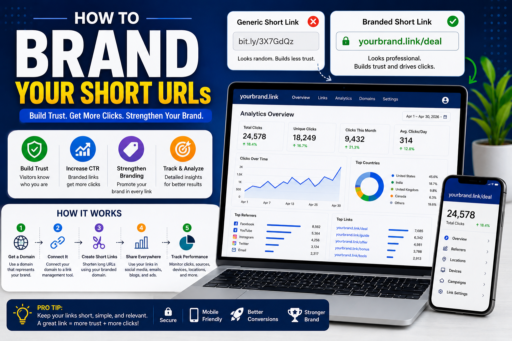
Building trust online has become increasingly important as digital marketing continues growing across blogs, social media platforms, email campaigns, affiliate marketing, and online businesses. One of the most overlooked branding opportunities is the use of custom short links. Learning How to Brand Your Short URLs can help businesses improve credibility, increase click-through rates, strengthen brand recognition, and create a more professional online presence.
Many marketers rely on generic URL shorteners that produce links containing random characters and unfamiliar domains. While these links function correctly, they often fail to build trust with users. Branded short URLs solve this problem by allowing businesses to use custom domains that reflect their brand identity.
Instead of sharing a generic shortened link, marketers can create memorable URLs that reinforce their company name, products, or marketing campaigns. This small adjustment can significantly impact audience perception and engagement.
In this guide, you’ll learn how branded short URLs work, why they matter, how to create them, and which tools provide the best solutions in 2026.
What Are Branded Short URLs?
Branded short URLs are shortened links that use a custom domain owned by the business or marketer instead of a generic shortening service domain.
For example:
- Generic Link: bit.ly/example123
- Branded Link: yourbrand.co/deal
The second example immediately appears more trustworthy and professional because it clearly identifies the source.
This branding advantage is one reason why many companies invest in custom short-link domains.
Why Branded Links Matter
Learning How to Brand Your Short URLs is important because branding influences user behavior.
People are more likely to click links when they recognize and trust the source.
Branded links help achieve this by:
- Increasing trust
- Improving brand awareness
- Boosting click-through rates
- Creating professional-looking campaigns
- Improving link memorability
- Supporting marketing consistency
These benefits make branded links valuable for businesses of all sizes.
How Branded URLs Improve Click-Through Rates
Studies and industry reports consistently suggest that recognizable links tend to attract more clicks than unfamiliar ones.
When users see a branded URL, they immediately gain context about where the link leads.
This familiarity reduces uncertainty and often increases engagement.
For affiliate marketers, bloggers, and content creators, even a small improvement in click-through rate can significantly impact results over time.
Generic Short Links vs Branded Short Links
| Feature | Generic Links | Branded Links |
|---|---|---|
| Trust | Moderate | High |
| Brand Recognition | Low | High |
| Professional Appearance | Basic | Strong |
| Memorability | Limited | Excellent |
| Marketing Value | Moderate | High |
For serious marketers, branded URLs typically provide greater long-term value.
How to Choose a Branded Domain
The first step in creating branded URLs is selecting an appropriate domain.
Many businesses choose shorter versions of their primary domain.
Examples include:
- brand.link
- brand.co
- go.brand.com
- links.brand.com
The goal is to create something memorable, easy to type, and clearly connected to your brand.
Using Rebrandly for Branded Links
Among the most popular solutions for How to Brand Your Short URLs, Rebrandly remains one of the leading platforms available.
Rebrandly specializes in custom branded links and provides marketers with extensive customization options.
The platform allows users to connect custom domains, create branded links, and monitor performance through detailed analytics.
Key Features
- Custom domains
- Branded links
- Click tracking
- Analytics reporting
- Campaign management
- Team collaboration
Pros
- Excellent branding tools
- Strong analytics
- Professional appearance
- Easy implementation
Cons
- Advanced plans can be expensive
- Requires custom domain ownership
Marketers interested in branded links can learn more through the official Rebrandly website.
Using Short.io for Custom URL Branding
Short.io is another powerful platform that supports branded link creation.
Many marketers choose Short.io because it combines advanced targeting options with flexible domain management.
The platform supports:
- Custom domains
- Geo-targeting
- Device targeting
- Advanced analytics
- Campaign reporting
This combination makes it attractive for performance-focused marketing campaigns.
Creating Branded URLs for Affiliate Marketing
How to Brand Your Short URLs is especially important for affiliate marketers, who often benefit significantly from branded URLs that increase credibility and improve click-through rates.
Traditional affiliate links can appear lengthy and complicated, sometimes reducing trust.
Branded links provide a cleaner alternative while maintaining full tracking functionality.
This often leads to stronger user confidence and improved campaign performance.
If you’re still evaluating shortening platforms, you may also find our guide on Best URL Shorteners for Affiliate Links helpful.
Branded Links and Social Media Marketing
Social media platforms are one of the most common places where branded links are used.
Platforms such as:
- X
- YouTube
often benefit from cleaner, more professional URLs.
Branded links help maintain consistency while reinforcing brand identity across multiple channels.
How Branded Links Improve Trust
Trust is one of the most important factors influencing online engagement.
Users are naturally cautious about clicking unfamiliar URLs.
Branded domains reduce uncertainty by clearly identifying the organization behind the link.
This transparency often leads to better engagement and stronger click performance.
Tracking Performance of Branded Links
One of the biggest advantages of branded links is that they retain all the analytics benefits associated with traditional URL shorteners.
Marketers can monitor:
- Total clicks
- Unique visitors
- Geographic locations
- Device types
- Referral sources
- Campaign performance
These insights help marketers refine campaigns and improve future performance.
Combining Branding With Analytics
Successful marketers rarely focus on branding alone.
They combine branding with performance measurement.
If you’re interested in monitoring campaign results, our guide on How to Track Clicks With Short Links explains how marketers use analytics to improve decision-making.
This combination of branding and measurement creates a powerful marketing advantage.
Best Practices for Branded Short URLs
Creating branded links is only the first step. To maximize effectiveness, marketers should follow several best practices.
Successful branded URLs are:
- Short and memorable
- Easy to type
- Relevant to the destination
- Consistent with branding
- Simple to understand
For example, a branded URL such as brand.co/tools is generally more effective than a random sequence of characters.
Clear and meaningful URLs improve both user trust and click-through rates.
Keeping Link Structures Consistent
Consistency plays a major role in branding.
Organizations should develop a standard naming convention for campaigns and promotions.
Examples include:
- brand.co/deal
- brand.co/guide
- brand.co/tools
- brand.co/review
This consistency makes links easier to recognize while reinforcing brand identity.
Using Branded URLs in Email Marketing
Email marketing campaigns often benefit significantly from branded links.
Subscribers are generally more likely to click URLs that clearly identify the sender.
Branded links can improve:
- Email engagement
- Click-through rates
- Brand recognition
- User trust
For businesses sending newsletters regularly, branded URLs can become an important part of their marketing strategy.
Using Branded URLs on Social Media
Social media audiences often encounter dozens of links every day.
Branded URLs help content stand out by making links appear more professional and recognizable.
Whether used on Facebook, Instagram, X, Pinterest, LinkedIn, or YouTube, branded links contribute to a more consistent marketing presence.
Over time, users may begin associating those branded links directly with your business.
Building Brand Recognition Through Links
Every interaction with your audience contributes to brand awareness.
Learning How to Brand Your Short URLs allows marketers to transform ordinary links into branding assets.
Rather than promoting another company’s shortening domain, businesses can reinforce their own identity every time a link is shared.
This approach creates cumulative branding benefits over months and years.
How Branded Links Support Customer Trust
Trust is often one of the biggest challenges in online marketing.
Users are naturally cautious about unfamiliar URLs.
Branded domains reduce uncertainty by clearly identifying the source before visitors click.
This transparency frequently improves engagement and contributes to stronger customer relationships.
Monitoring Branded Link Performance
Successful branding efforts should always be measured.
Most branded-link platforms provide detailed reporting that helps marketers evaluate performance.
Useful metrics include:
- Total clicks
- Unique visitors
- Traffic sources
- Device usage
- Geographic locations
- Campaign engagement
These insights help marketers determine which campaigns produce the strongest results.
Comparing Branded Link Campaigns
Many businesses run multiple marketing campaigns simultaneously.
Creating separate branded links for each campaign allows marketers to compare performance accurately.
For example:
- brand.co/summer
- brand.co/newsletter
- brand.co/youtube
- brand.co/pinterest
Each URL can be tracked independently, making optimization easier.
Combining Branded Links With Analytics Platforms
Branded links become even more valuable when combined with website analytics tools.
Analytics platforms provide deeper insights into visitor behavior after users click links.
If you’re interested in broader performance reporting, our guide on Best Website Analytics Tools Compared explores several popular analytics solutions.
Together, branded links and analytics platforms create a comprehensive measurement system.
Common Branding Mistakes
Many marketers unintentionally reduce the effectiveness of their branded URLs.
Common mistakes include:
- Using long link slugs
- Inconsistent naming conventions
- Ignoring analytics
- Using confusing abbreviations
- Choosing difficult-to-remember domains
Avoiding these mistakes can improve both usability and campaign performance.
Choosing the Right Domain Extension
Domain extensions can influence how branded links are perceived.
Popular options include:
- .com
- .co
- .link
- .io
- .ly
The best choice depends on brand identity, availability, and marketing objectives.
Regardless of the extension selected, simplicity should remain a priority.
How Large Brands Use Branded Links
Many major companies use custom short-link domains as part of their marketing strategies.
These organizations understand that every shared URL represents an opportunity to reinforce brand recognition.
By controlling link appearance, businesses maintain consistency across campaigns while improving trust and engagement.
Advanced Branding Strategies
Experienced marketers often go beyond basic branded links.
Advanced strategies include:
- Campaign-specific domains
- Localized branded links
- Audience segmentation
- Custom landing page integration
- A/B testing branded URLs
These techniques can provide deeper insights and stronger campaign performance.
How Branded URLs Support Long-Term Growth
Brand recognition compounds over time.
Every campaign, social media post, email newsletter, and blog article contributes to audience familiarity.
Because branded links consistently reinforce the same identity, they become a valuable long-term marketing asset.
This cumulative effect can strengthen trust while improving engagement across multiple channels.
The Future of Branded Short URLs
Branded links continue evolving alongside digital marketing technology.
Future platforms will likely offer deeper analytics, AI-powered recommendations, stronger integrations, and more advanced personalization capabilities.
As competition increases online, branding opportunities that improve trust and visibility will become even more important.
Final Thoughts
Learning How to Brand Your Short URLs is a simple yet powerful way to improve marketing performance.
Branded links help businesses increase trust, strengthen brand recognition, improve click-through rates, and create more professional campaigns.
Platforms such as Rebrandly and Short.io make it easier than ever to create custom short links while maintaining detailed performance analytics.
When combined with click tracking, analytics, and consistent branding strategies, branded URLs can become valuable assets that support long-term growth throughout 2026 and beyond.