
Missing a credit card payment can happen to almost anyone. Understanding what happens if you miss a credit card payment is important because people sometimes forget a due date, face unexpected financial problems, or simply lose track of their bills. However, even one missed payment can create financial consequences if it is not handled quickly.
Understanding what happens if you miss a credit card payment can help you reduce damage, avoid future mistakes, and protect your credit score.
The good news is that the earlier you act, the better your chances of minimizing long-term financial problems.
In this beginner-friendly guide, you will learn:
- What happens after a missed payment
- How missed payments affect your credit score
- When late fees are charged
- What penalty APR means
- How to recover after missing payments
- Ways to prevent future missed payments
- Common mistakes to avoid
What Happens If You Miss a Credit Card Payment?
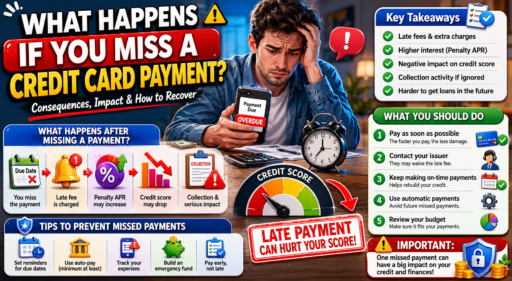
Missing a payment means you fail to make at least the minimum required payment by the due date.
Depending on how late the payment becomes, consequences may include:
- Late fees
- Interest charges
- Penalty APR increases
- Credit score damage
- Collection activity
The severity usually depends on how long the payment remains unpaid.
Why What Happens If You Miss a Credit Card Payment Matters
Even one missed payment can create financial problems if ignored.
Missed payments may affect:
- Your credit score
- Future loan approvals
- Interest rates
- Financial flexibility
- Stress levels
According to Consumer Financial Protection Bureau, missed credit card payments can lead to fees, interest increases, and negative credit reporting.
What Happens Immediately After Missing a Payment?
If you miss the due date by only a few days, the consequences may still be limited initially.
You may experience:
- Late payment reminders
- A late fee
- Interest charges
However, many issuers do not report late payments to credit bureaus immediately.
The 30-Day Rule and Credit Reporting
Most credit card companies usually report missed payments to credit bureaus once they become at least 30 days late.
This is extremely important because reported late payments may stay on your credit report for years.
The longer the payment remains unpaid, the more serious the damage may become.
Late Fees Explained
Most issuers charge late fees after missed payments.
Late fees vary depending on:
- Your card agreement
- Issuer policies
- Whether you missed payments before
Repeated missed payments may lead to larger fees over time.
Penalty APR Explained
Some issuers apply a penalty APR after missed payments.
A penalty APR is a much higher interest rate applied to your balance.
This can make debt repayment significantly more expensive.
If you want to reduce interest problems, read our guide on Best Credit Card Habits for Good Credit.
How Missed Payments Affect Your Credit Score
Payment history is one of the most important factors affecting credit scores.
Missed payments may:
- Lower your score
- Reduce lender trust
- Increase future borrowing costs
People with strong scores sometimes experience larger score drops because they previously had excellent payment histories.
How Long Late Payments Stay on Your Credit Report
Reported missed payments may remain on your credit report for several years.
However, the negative impact usually decreases gradually over time if you build better habits afterward.
What Happens If You Miss Multiple Payments?
Multiple missed payments increase financial risk significantly.
Possible consequences include:
- Higher fees
- Collection activity
- Account closure
- Severe credit score damage
- Legal action in extreme cases
The earlier you respond, the easier recovery becomes.
Can You Fix a Missed Payment Quickly?
If you notice the missed payment quickly, paying immediately may reduce damage.
In some cases:
- You may avoid credit bureau reporting
- The issuer may waive fees
- You may avoid penalty APR increases
Fast action is extremely important.
Contact Your Credit Card Issuer
If you missed a payment accidentally, contacting your issuer may help.
Some issuers may:
- Waive late fees
- Remove penalties
- Offer hardship programs
This is especially possible if you previously had a strong payment history.
How to Recover After Missing a Payment
1. Pay as Soon as Possible
The faster you pay, the better.
2. Continue Making On-Time Payments
Consistent future payments help rebuild your profile.
3. Reduce Credit Utilization
Lower balances may help improve your score gradually.
Learn more in our guide on Credit Utilization Explained for Beginners.
4. Create a Better Payment System
Organization reduces future mistakes.
Use Automatic Payments
Automatic payments are one of the best ways to prevent missed payments.
Many people automate at least the minimum payment to avoid accidental late payments.
Track Due Dates Carefully
Helpful tools include:
- Phone reminders
- Calendar alerts
- Banking notifications
- Budgeting apps
Small organizational habits can prevent major financial problems.
Build an Emergency Fund
Unexpected expenses often contribute to missed payments.
An emergency fund can provide temporary protection during:
- Job loss
- Medical expenses
- Car repairs
- Unexpected bills
Even small emergency savings can help reduce financial stress.
How to Prevent Missed Payments in the Future
- Pay early instead of waiting
- Use automatic payments
- Track spending regularly
- Reduce unnecessary debt
- Review statements monthly
If you want stronger financial habits, read our article on Secured Credit Cards vs Unsecured Cards.
Common Mistakes After Missing a Payment
1. Ignoring the Problem
Waiting usually makes the situation worse.
2. Missing Additional Payments
Multiple missed payments create larger financial damage.
3. Continuing to Overspend
New debt increases repayment difficulty.
4. Not Contacting the Issuer
Communication may provide helpful solutions.
5. Losing Motivation
Financial recovery takes time and consistency.
Best Beginner Strategy After Missing a Payment
If you accidentally miss a payment:
- Pay immediately
- Contact the issuer
- Review your budget
- Use automatic payments
- Avoid additional missed payments
One missed payment does not permanently ruin your financial future — but ignoring the situation can make recovery harder.
Final Thoughts on What Happens If You Miss a Credit Card Payment
Understanding what happens if you miss a credit card payment can help you react quickly, reduce financial damage, and protect your credit score.
Missed payments can create serious consequences over time, but early action often makes recovery much easier.
The most important habits are simple:
- Pay on time
- Stay organized
- Track due dates
- Use automatic payments
- Communicate with your issuer
Most importantly, remember that financial mistakes happen. What matters most is how quickly and responsibly you respond afterward.