
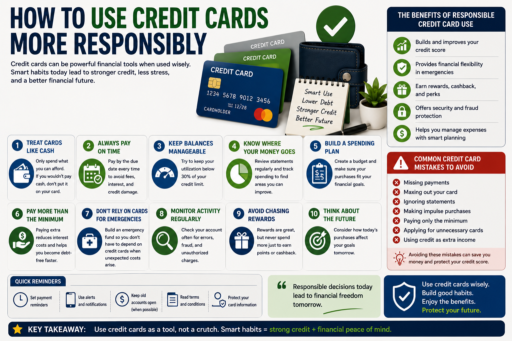
Credit cards can be incredibly useful financial tools. Learning how to use credit cards more responsibly can help you benefit from the convenience, security, fraud protection, rewards programs, and opportunities to build credit history they offer. Yet for many consumers, credit cards also become a source of stress, growing debt, and financial mistakes.
The difference often comes down to how the cards are used.
Imagine two people receiving the exact same credit card with the same limit. One uses it carefully, pays balances on time, tracks spending, and treats the card as a financial tool. The other views the card as extra spending money, carries high balances, and rarely checks account activity.
Several years later, their financial situations may look completely different.
The card itself was not the problem. The habits surrounding it made the difference.
Learning how to Use Credit Cards More Responsibly can help you strengthen your credit profile, reduce financial stress, avoid unnecessary debt, and improve long-term financial health.
The good news is that responsible credit card use does not require complicated financial strategies. In most cases, it comes down to a series of simple habits practiced consistently over time.
In this guide, we’ll explore practical ways to use credit cards wisely while avoiding many of the common mistakes that create financial problems.
Why Credit Cards Get So Many People Into Trouble
Credit cards themselves are not inherently good or bad.
However, they make spending extremely easy.
When cash leaves your wallet, the transaction feels immediate. Credit cards often create a psychological distance between spending and repayment.
This can encourage consumers to spend more than they originally intended.
Many financial problems begin gradually.
A few unnecessary purchases become recurring habits. Small balances grow larger. Interest charges begin accumulating.
Over time, what seemed manageable can become difficult to control.
Understanding this risk is the first step toward responsible credit card management.
Responsible Habit #1: Treat Credit Cards Like Cash
One of the most effective mindset shifts is viewing credit cards as payment tools rather than borrowing tools.
Before making a purchase, ask yourself a simple question:
Would I still buy this if I had to pay cash right now?
This question encourages more intentional spending.
Many financially successful consumers use credit cards for convenience and rewards but make purchasing decisions based on their actual budget—not their available credit limit.
The goal is to spend according to income rather than available credit.
Responsible Habit #2: Always Pay on Time
If there is one rule every credit card user should follow, it is paying on time.
Late payments can create multiple problems simultaneously.
- Additional fees.
- Interest charges.
- Credit profile damage.
- Financial stress.
Many people miss payments simply because they become busy or forget due dates.
Automatic payments, reminders, and monthly financial reviews can significantly reduce this risk.
Consistency matters far more than perfection.
Responsible Habit #3: Keep Balances Manageable
One of the most common mistakes credit card users make is allowing balances to grow too large.
Imagine carrying a balance that consumes most of your available credit limit.
Even if payments are made on time, high balances can increase financial pressure and make debt more difficult to eliminate.
Keeping balances manageable provides greater flexibility and often supports healthier credit outcomes.
Related Article: How Credit Utilization Affects Your Score
Responsible Habit #4: Understand Where Your Money Goes
Many consumers know approximately how much they spend each month.
Far fewer know exactly where the money goes.
Credit card statements can provide valuable insights into spending behavior.
Reviewing transactions regularly may reveal:
- Impulse purchases.
- Unused subscriptions.
- Recurring charges.
- Areas of overspending.
Awareness often leads to better financial decisions.
Responsible Habit #5: Build a Spending Plan Before Using Credit
Responsible credit card use starts before the purchase happens.
Consumers who create spending plans often find it easier to stay within their financial limits.
A budget does not need to be complicated.
Even a simple monthly spending plan can help ensure that credit card purchases align with larger financial goals rather than short-term impulses.
Related Article: Best Financial Decisions That Improve Credit
Responsible Habit #6: Pay More Than the Minimum Whenever Possible
Minimum payments exist for a reason. They help consumers keep accounts current and avoid late-payment penalties.
However, relying on minimum payments for extended periods can become expensive.
Imagine carrying a balance of several thousand dollars while paying only the minimum amount each month.
The balance may decline very slowly, while interest charges continue accumulating in the background.
This often creates the illusion of progress while keeping consumers in debt longer than necessary.
Whenever possible, paying more than the minimum can help reduce balances faster, lower interest costs, and improve overall financial flexibility.
Responsible Habit #7: Avoid Using Credit Cards for Emergencies Alone
Many consumers treat credit cards as their emergency fund.
While credit cards can certainly provide temporary financial flexibility, relying on them as the only backup plan can create problems.
Imagine facing an unexpected medical bill, vehicle repair, or job interruption.
If your only solution is additional credit card debt, financial stress can increase quickly.
This is why emergency savings remain so important.
Even a modest emergency fund may help reduce reliance on high-interest borrowing during difficult situations.
Responsible financial planning often involves both savings and credit management working together.
Responsible Habit #8: Monitor Your Credit Card Activity Regularly
Many people review statements only when making a payment.
However, checking account activity regularly can provide several benefits.
You may identify:
- Unauthorized transactions.
- Subscription charges you forgot about.
- Spending patterns that need adjustment.
- Potential fraud.
- Budgeting opportunities.
Regular monitoring increases awareness and helps prevent small issues from becoming larger problems.
Related Article: How to Build Credit Responsibly
Responsible Habit #9: Resist the Temptation of Every Reward Offer
Rewards programs can be valuable.
Cashback, travel points, discounts, and promotional bonuses often attract consumers.
The danger occurs when rewards influence spending decisions.
Imagine buying something you never planned to purchase simply because a promotion offered extra points.
In that situation, the reward may actually cost more than it saves.
The most financially successful credit card users view rewards as a bonus—not a reason to spend.
Smart spending should always come before reward chasing.
Responsible Habit #10: Think About Future Consequences
One characteristic shared by responsible credit card users is long-term thinking.
Before making a purchase, consider how it might affect future financial goals.
A purchase that feels harmless today may create pressure next month.
Likewise, a balance carried for several months can reduce financial flexibility when unexpected opportunities or expenses arise.
Instead of asking only whether you can afford a purchase today, consider whether it supports your broader financial goals.
Small decisions often shape larger outcomes over time.
Common Credit Card Mistakes to Avoid
Many consumers develop problems not because they lack financial knowledge, but because they repeat a few common mistakes.
Examples include:
- Missing payment deadlines.
- Maxing out credit cards.
- Ignoring statements.
- Making impulse purchases.
- Paying only the minimum indefinitely.
- Using rewards as justification for spending.
- Applying for unnecessary credit cards.
Recognizing these mistakes early often prevents larger financial problems later.
Related Article: How to Avoid Common Credit Mistakes
A Real-Life Example of Responsible Credit Card Use
Consider two individuals who receive similar credit cards with identical limits.
The first person uses the card primarily for planned purchases, pays balances consistently, reviews statements monthly, and maintains emergency savings.
The second person frequently makes impulse purchases, carries growing balances, and pays little attention to account activity.
After several years, their financial situations may look dramatically different.
The first individual often enjoys stronger credit, lower stress, and greater financial flexibility.
The second may struggle with higher balances, increased interest costs, and reduced financial options.
The difference is not the card itself.
It is the habits surrounding the card.
How Responsible Credit Card Use Supports Better Credit
Credit cards influence several factors that contribute to overall credit health.
Responsible use can help support:
- Positive payment history.
- Healthier utilization levels.
- Long-term account history.
- Better financial organization.
- Improved credit management habits.
Strong credit profiles are often built through consistent behavior rather than dramatic actions.
Related Article: Best Credit Habits for Better Financial Health
Frequently Asked Questions
Should I pay my credit card in full every month?
Whenever possible, paying balances in full can help avoid interest charges and support healthier financial habits.
Is it bad to use a credit card every day?
Not necessarily. Daily use can be perfectly responsible when spending remains within budget and balances are managed carefully.
How many credit cards should I have?
There is no perfect number. The focus should be on managing accounts responsibly rather than accumulating cards unnecessarily.
Can responsible credit card use improve my credit score?
Yes. Responsible habits such as on-time payments and manageable utilization often contribute to stronger credit profiles over time.
Should I close unused credit cards?
The answer depends on your financial situation. Consider account age, available credit, and overall financial goals before making a decision.
What is the biggest mistake credit card users make?
One of the most common mistakes is treating available credit as additional income instead of borrowed money.
Additional Resources for Credit Card Education
Learning about responsible credit card use can help consumers avoid mistakes and build healthier financial habits.
For additional information about credit card education resources, the Consumer Financial Protection Bureau provides guidance covering credit cards, borrowing, consumer rights, and responsible credit management.
Related Article: How to Avoid Credit Card Interest
Related Article: Best Credit Score Tracking Tools
Final Thoughts
Learning how to Use Credit Cards More Responsibly is not about avoiding credit cards altogether. Instead, it is about using them in a way that supports your financial goals rather than working against them.
Responsible credit card use often comes down to a handful of simple habits: spending intentionally, paying on time, keeping balances manageable, monitoring activity regularly, and thinking long term.
The encouraging news is that small improvements can create meaningful results. By developing better habits today, you can reduce financial stress, strengthen your credit profile, and create greater financial opportunities in the future.